Showing posts with label Empire. Show all posts

Sunday, November 18, 2012

OMG Khazars Part 2

What Up, Nerds?

So OMG Khazars Part 1 ended up on r/history the other day, which was nice.

In the comments, redditor kapsama left an answer to my question about what made the Khazar bigwigs decide to convert to Judaism. In his or her words, "... converting to Judaism was a political decision. Converting to Islam or (Orthodox) Christianity would have meant being second fiddle to the worldy and spiritual leaders of those religions in the form of the Caliph and Eastern Roman Emperor respectively. Judaism had no such leaders at the time."

That's a right good answer kapsama. But like any answer that's short enough to make a decent comment, that's only part of the story.

Let's see where these Khazars go, y'all.


It's the moment of the Khazars' conversion. Let's figure out just what is happening.

Just who converted?
Well, we don't really know, but we think it was probably the Khagan. Or the Bek. Or maybe it was one guy who held both offices. And probably most of his nobles converted too. Maybe. Could be some of the rest of the populace did too. We think. Um. The history ain't that clear.

Okay, I was looking for something a little more specific. Let's try again. When did it happen?
Geez, you're not gonna like this. Let's say... 700 AD. Plus or minus a century. A few folks say it was 740, but others say other dates, and none of them have very compelling arguments for being right.

No, specific. I said specific. Try telling me how it happened.
This is awkward. Because we don't know.

There are some folks who say there was one great man, Rabbi Yitzak Ha-Sangari, who went to the Khagan and preached to him. Rabbi Yitzak preached so well that the Khagan soon converted, and he decreed that his subjects must convert as well. But we have no really reliable reason to believe that was how it went down.

Another tradition says that the Khagan decided that Tengriism was holding the Khazars back internationally. It made the Romans and the Arabs look down on them. So he decided the Khazars would convert to one of the big new "modern" Abrahamic faiths. He invited representatives from Christianity, Islam, and Judaism to his capital at Itil. And then they debated whose religion was the best.

According to at least one witty cartoonist, the Jews won the Khazars over by saying that Judaism preached the doctrine of Hot Chicks. If the debate ever happened it was almost certainly staged. And it's even less likely that hot chicks would have been the deciding argument.

Of course some folks think it happened in other ways. Some say that the nobility converted in order to assert control over all the Jewish immigrants from Persia and the Eastern Roman Empire. Some say that it was a calculated political move that the Bek undertook in order to gain the loyalty of Jews still living in the Arab and Roman worlds. Some say that a man who was already Jewish got himself made Bek.

Who knows what truly happened?

You'd better know, if you're gonna write a history blog like this. So how about you answer your own damn question from last week. Why did they convert?
Fine. Politics. It was almost certainly politics.

There's something to be said for sincere religious conversion. One Khagan or Bek might have been convinced that Moses had his stuff together. But when a whole nobility converts en masse, you'd be amiss not to look for political motivations. When a head of state converts in the middle ages it absolutely must be politically expedient. No Khagan had the power to convert his whole nation on a whim.

So why did the Khazars forsake Tengri?


Simply put, they stopped needing him. Tengri was a sky god. When they lived as nomads on the open plains, the sky was the dominant feature of their worlds. The Asian steppes were just as much "big sky country" as the American West is today. So Tengriism came into being in a way that suited a nomadic life on horseback.

But the Khazars gave up their nomadic life. They built a settled agricultural style of life for themselves. Not only did they learn to farm but they also adopted a western-style feudal system. They were the first society in eastern Europe to adopt that social structure. And a nomadic religion just didn't teach the values that feudalism needed a religion to instill. It became irrelevant to Khazars' lives so they chose to embrace a more "indoor" kind of religion.


Like kapsama said, Christianity and Islam were the two big imperial religions in town. Converting to Islam would mean adopting a worldview in which the Khazars should submit to the authority of Mohammed's successors and the dominion of the Caliphate. Christianity had no such early history of a unified church and central state. But in the Eastern Roman Empire the Emperor had spent centuries positioning himself as the Head of Christendom. He could make and unmake Partiarchs of Constantinople. He could persecute sects he disagreed with out of existence. Even in west Europe the idea of a Roman Emperor who led Christianity was strong--it manifested its self in Charlemagne's crowning as the Holy Roman Emperor.

 So adopting either Christianity or Islam would leave the Khazars "being second fiddle" to a more powerful empire.


But to keep the musical metaphor, choosing to play second fiddle with one of the empires would also preclude the Khazars from playing duets with the other empire.

The Khazars were situated in some prime real estate for trading. They were one one end of the trade routes that are collectively called the silk road. Chinese goods would flow west over central Asia and into Khazaria--where they flow out to the cities of the Roman Empire and the rest of the Mediterranean. And western goods and money would flow back east, passing through the hands and coin purses of the Khazar governors.

Additionally the Khazars were also on the eastern terminus of the great Northern Arc trade route. That trade network stretched from Ireland, across Scandinavia, to Khazaria and ultimately into the Arab world. The immense wealth of the viking Age flowed along this path. And as the trade passed through the Khazar domain the Khazar government took its cut. They grew rich on this trade between Muslims and vikings.


The trade routes, more or less. The Silk Road is in pink, the Northern Arc is in light blue.
If you look close you can actually see me getting less and less meticulous and detailed as the drawing progresses,

What would converting to Christianity or Islam have done to trade? It would be a little like declaring for the Russians or the Americans during the much more recent Cold War. If the Khazars became Christian, they might hold on to a little trade with the Muslims, but the Caliphate would still view them as the enemy.

And the Christians would mistrust and avoid the Khazars if they became Muslim. Like the Non-Aligned Movement in the Cold War, the Khazars didn't see how choosing sides would benefit them. So if the Khazars wanted to keep playing economic duets with both Christians and Muslims, they had to find a religion acceptable to everyone.

Therefore: Judaism.

Judaism has a reputation as a persecuted religion today. Now it was persecuted back then too, you'll remember how in OMG Khazars Part 1 lots of Jewish immigrants to Khazaria were actually fleeing Roman and Persian persecutions. But compared to most other religions of the time, Judaism was hardly persecuted at all. Jews might be forced to leave an empire occasionally. But other "pagan" religions were forced to either convert or be killed. Adherents of both Islam and Christianity are supposed to show respect for Jews, according to doctrine. So in they end they tended to begrudgingly tolerate them.

Meaning that if the Khazars became Jews then trade could continue with everybody.

And as kapsama also pointed out, there was no international head of Jewry. With no preeminent leadership, the Khazars could make themselves out to be the great protectors of the Jews. The Persian and Mizrahi Jews were particularly fond of the Khazars. They thought that the Khazars might one day come and sweep away their Muslim rulers, allowing them to return to Israel and end their "Second Babylonian Captivity." The Khazars sure raided the Muslims plenty. But they had no grand plans to sweep away the Caliphate.

Instead Khazar leadership of Judaism manifested its self in smaller ways. When a Synagogue was destroyed in Iran, the Khazar ruler symbolically "punished" the Muslims by tearing down the minaret on the mosque in his capital city, and then non-symbolically executing the muazzin. It wasn't enough to warrant a full scale invasion by the Caliphate. But it was enough to keep the Jews in the caliphate on his side. Subtle negotiation like this kept the Khazars at the head of the Jewish world for more than a century.


So the Khazars built the first feudal state in eastern Europe and stood astride the balance of power in Russia. As time marched on they subjugated almost all of the peoples who lived around them, and they grew wealthy on trade.


Greatest extent of the Khazar Khaganate in several shades of blue, with subjugated and tribute-paying nations in yellow.
~850 AD.

And they're about to come crashing down.

Come back next week to find out how it happened.


Sources:
Britannica Online Encyclopedia
Khazaria.com
Larry Gonick's  Cartoon History Series
JewishEncyclopedia.com
JewishVirtualLibrary.com
and of course, Wikipedia

OMG Khazars Part 1

What Up, Nerds?

So. I haven't written any posts in a long time.


It may be the case that nobody ever really reads me, in which case nobody is unhappy. But maybe there are one or two of you out there who have checked my blog in the last few months. Maybe there are even one or two of you who have missed this little dose of history each week. If so, I appreciate you dearly. And I apologize to you for not posting for so long. I'm sorry.

I hope I can make it up to you by telling you about some poorly known Jews. Khazars are on the menu, y'all!


The story starts a long ways back.

In the 500's AD the Turks erupted out of modern Mongolia. That's pretty par for the course in central Asia--it's just a place that spawns huge nomadic hordes that ricochet all around Eurasia. Like the Huns before them and the Mongols after them that's where the Turks started.


This Turkish Göktürk empire spread pretty quickly. It was led by the Ashina clan, who will dominate the early history of these peoples. As they conquered, they assimilated the conquered people who became "Turks" themselves. The cascading wave of new and old Turks were going to keep pouring into lands from Manchuria to Persia, Turkey, and the Balkans from then through the 1600's. But back then they were still only really in central Asia.

Eurasia at the height of the Göktürk Empire, mid 500's AD.


The Empire lasted for a while. But when the fourth Ashina Khagan of the Turks died in the 580's, the eastern and western halves of the Göktürk empire supported rival Turkish princes who both wanted to be the new Khagan. Seeing the fracturing of the empire, more claimants to the throne declared themselves Khagan and there were many wars in between them. The power of the Ashina clan splintered. The western Khagan almost conquered the east. The easterners almost conquered each other. But in the end nobody could quite swing it. So the west and the east of the empire were permanently split.

Soon the east started to buckle under military pressure from the native Uyghur people.

The Ashina Khagan of the West focused on the defense and the stability of his realm. Maybe because of that, the west remained stronger. Around the year 630 he allied with the Eastern Roman Empire to drive back the invading Persians. He succeeded. The Western Turks also stayed in close contact with Tang China. They might have even married into the Tang royal family. While the alliance lasted it brought a lot of prestige and some amazing trading opportunities for the Turks. Being friends with the two biggest empires in the world had benefits.

But eventually that close connection with the Tang Chinese went bad. In the year 657 the reigning Khagan fell afoul of the emperor and a Chinese army was promptly dispatched.  The invaders easily conquered the eastern half of the West Göktürk empire. Since the Tang Emperor had already conquered the eastern Göktürks, he had himself proclaimed the new Khagan of the Göktürks.

Poor Ashina. There goes their legacy.


The Chinese dominion over central Asia didn't really last. The resurgent Uyghurs broke Chinese power, and then the Uyghurs fell to the Turks again. But the Chinese conquest did what we needed it to do for this story--it broke up the great Göktürk Empire.

So what happened to that half of the Western Göktürk Empire that the Tang didn't conquer? The far west remained free, and a member of a small branch of the original Ashina clan was still the Khagan. By then those Turks who remained there had a new name for themselves. They called themselves the Khazars.

At least that's where we think the Khazars came from. The Khazars didn't write any of this down. So we have to rely on the records of the Eastern Roman Empire and the Tang Chinese Empire.

And you know how these sorts of things go. When a huge horde first invades they all look the same, they look like one massive military juggernaut. But then they settle down in the neighborhood and take a break from invading you. And then you notice things about your neighbors. And you realize the horde is made up of many separate and interesting groups. Who knows where they originally came from? Who knows precisely who they first were? What I am telling you is that we don't know the origins of the Khazars for sure. Maybe they were just associated with the main body of Göktürks. But a good chunk of the literature suggests the true story is probably what I just told you.

Whatever happened, the Khazars were a big presence in southern Russia by the second half of the 600's AD. They soon clashed with the Bulgar Khaganate of Old Great Bulgaria. By 670 they had whooped the Bulgars, whose whole society split up. Half went south and settled in modern Bulgaria. The other half went north and settled around the middle Volga river. The northerners formed Volga Bulgaria under the domination of the nearby Khazars.


The Khazar Khaganate before conquering the Bulgars (650 AD) in the darkest blue, and after the conquest (750 AD) in medium-dark blue. Old Great Bulgaria is showed grayed out, in the area of modern Ukraine. The other great powers also labeled.
The lightest grey-blue will be the Khazar Khaganate at its height.

While this was going on there were at least three other important developments.


The first development was political. Unlike in the Göktürk imperial system, the Khagan of the Khazars was not the supreme leader. The Khagan was the supreme spiritual and religious leader, a holy symbol of the glorious Ashina past. But the political and especially the military power rested with the Bek. The Bek was officially a co-king with the Ashina Khagan, but in practice he was more. A good comparison might be with the Japanese Shogunate system. The divine favor rested with the Ashina monarchs, but the warlord Bek would take as much power as he could.


The second development was the beginning of a whole series of wars against the Muslims. The Islamic Caliphate had swept to prominence in the mid 600's and its northern border fell along the Caucasus mountains. That was the border because that was where the Khazar armies put a hard stop to Muslim expansion. Khazar history is filled with victorious battles over the Arabs. It's the Khazars who stopped the early expansion of Islam to the north. There are some interesting stories, but the borders never really changed.


The third important development was religious. Like all Turks the Khazars had originally been polytheists. Their particular form of worship centered around the sky god Tengri. He was at the center of their pantheon, but the practical side of Tengriism was adapted from some Buddhist and Chinese practices. Specifically, the Turks believed in the Mandate of Heaven. According to the Turkish version of the Mandate of Heaven, the Ashina clan was specially chosen to rule and that they enjoyed Tengri's favor. But if Tengri revoked that favor from an individual and that person failed in their royal duties then that individual could be executed. It had happened in the past. So being a Göktürk Khagan was a risky job.

But the Khazars weren't exclusive Terngriists. They didn't mind foreiners bringing their own gods in. Tengriists, Christians, Muslims, Jews, Zoroastrians, Buddhists, Ancestor Worshipers and others were all welcomed as long as they brought prosperity. But by the late 600's the number of Jews in the Khazar Khaganate had grown disproportionately.

Khazaria wasn't unique in having Jewish citizens, but there were just a lot more Jewish immigrants in the Khazar Khaganate then there were elsewhere. The Khagan and Bek welcomed refugees from anti-Jewish persecutions in the Eastern Roman and Persian Empires. They welcomed immigrants who could bring wealth with them, and who could be good Khazar citizens. Large Jewish communities came to dominate certain places in Khazar society. Especially in the Greek settlements along the northern shore of the black sea. And just like any large ethnic or religious community, the Jewish community attracted more Jews still.


Found in excavations at Khazar archeological sites.
(Pic via Wiki)

So the Khazar Khaganate hosted an ever-growing population of Jews.

Time marched on and the Khazars looked after themselves. Things seemed good. Two Khazar princesses married Eastern Roman emperors. The Khazars invaded the Caliphate, were invaded by the Caliphate, followed a woman named Parsbit to expel the invaders, and went right back to their traditional raiding of northern Persia.


And then sometime in the late 700's or early 800's, the Khazar nobles converted to Judaism en masse.

What made the bigwigs decide to switch?

Come back next week to find out.


Sources:
Britannica Online Encyclopedia
Khazaria.com
Larry Gonick's  Cartoon History Series
and of course, Wikipedia

Friday, September 28, 2012

OMG A Letter About Triangles


What Up, Nerd?

Dear Nora, 


Heya, friend. Do you remember, weeks ago, when I said I'd tell you more about what I been reading? About the discovery of Cunieform writing? Well I wrote this letter to you to tell you what precisely that's been.

But then I nerded out so hard that my letter spilled over and became a blog post too. I hope you don't feel offended that I'd repurpose something I wrote for you to be a blog post. I certainly did not set out to whore out our interpersonal nerdery for blogging material.


Well the story with Cuneiform starts a few hundred years back. For a long time people knew about these totally awesome desert ruins way out in Persia. All the upper-class European tourists liked to go see 'em but nobody knew what they were. Just your average mystical desert ruins.
They probably looked cooler back then.
(Pic from Wiki)
The buildings and remains were pretty awesome by themselves. But they left you with the usual mysteries. Who built this? Why did they build it? What was it built for?

Well they also had some sort of strange and ancient and triangle-shaped writing carved all around the site. The most impressive inscriptions were carved into a huge cliff nearby. If they could somehow learn to read the triangular writing then they they could solve the desert mystery. But they had no idea how to even think about reading the triangles.

If the rich Europeans who went to see the site had know how to properly excavate then maybe archaeology could have helped them to solve their questions about the ruins. But archaeology was still a century away from being invented. And the practice was even longer off from becoming anything more than glorified treasure-hunting. And so the mystery of the ruins remained impenetrable.

Then in 1755 a French guy from Paris named Abe got his hands on a copy of a book called the Zend-Avesta. The Zend-Avesta was the holy text of the ancient Persian religion, Zoroastrianism. And Abe was a bit of a nerd for everything he thought seemed "oriental." So when he got his hands on the Zend-Avesta he did his research and found that somebody else had already translated the book into a Pakistani language hundreds of years earlier. He learned that particular Pakistani language and then used the translation of the Zend-Avesta to learn the book's language. And then he translated the book into French. Abe named the language of the Zend-Avesta after the book, so he called it Avestan.

Avestan wasn't exactly the standard ancient Persian language. But it was related to Persian in kind of the same way that Scottish Vernacular and Jamaican Vernacular English are related to each other.

So you know, it was related, but sounded real different

This really excited a nerd named George from Germany. It excited him a lot. It excited him because George was a massive nerd for Languages. He was almost what you might call an early linguist. And getting Abe's translation from the Avestan language gave George a chance to do something no one ever had before.


A lot of people in Europe were real interested in the triangle-ish writing that they had found in those ancient ruins in Persia. But nobody could figure out what that triangle-writing said. George planned to use his new knowledge of Avestan to crack the triangle code. If he succeeded he'd become famous all across Europe. And now that Abe had gone and given him a language that was closely related to ancient Persian he thought he could solve the language. 

The writing systems for Persian and Avestan were completely different, but George just didn't care. He had a bunch of little triangles and a French translation of a language that wasn't ancient Persian. And he was gonna be damned if he didn't somehow translate those triangles.


I don't know why I added the cats. I need to cut back the caffeine.

George got a copy of the inscriptions and turned his brain-engine on full steam. Other people had already looked at them and figured out that there were only really forty nine different kinds of characters, so George figured that the script had to be a kind of alphabet. And there were probably less than forty nine letters, because some of the characters were probably numbers and that sort of thing. But that still didn't make reading what the text said a simple task.


It says "Darius, the great king, king of kings, king of countries,
son of Hystapses, an Achaemenian, who built this place."
Well Nora, here is where I suspect either of us would have just been like "It says triangle triangle triangle triangle" and left it there. But some people had already though about how to decipher it. George did more. He decided that the sign that was one single diagonal triangle was probably used to separate words because A) it was so common and B)  it just kind of looked like a space.

Then George decided that, the most common sequence of letters was probably the Persian word for "king." He thought so because the word was on a big impressive carving and  the word was often written near pictures of very regal looking men.

He looked at the most common series of symbols, the series he thought meant "king" and noticed one place where the left half of the word was on the right end of a line, and then the right half was on the left end of the line below it. It was almost like the writer had started writing the word, run out of space, and finished the word on the line below. Because the left part of the word was on the line above the right part of the word, he decided the language was probably read from left to right.

And he was very right about almost all of that.


The word-divider is in pink, the word for "king" is highlighted in white.
In the inscriptions next to a couple carvings of royal-looking figures there was one first word right before that second word that meant "king." George figured out that that word was probably the king's name.

Then because the king's name from one of the inscriptions was also in the third line of the second inscription, George decided that that meant the second carving described the second king as the son of the first.

The ancient Greeks had written all about Persian kings when they wrote their histories of the Persian Wars. So George had a list of their names. He looked to those writings to find out which names these might be.

The big clue he had was that the father of one of the kings was not a king himself. Where the inscription listed his father, the word for king did not appear. Only two father/son sets of Persian kings fit this criteria. Of the two possibilities, George decided that the kings were probably the most famous father/son pair in the Greek writing about the Persian kings. They were the two Persian kings who had invaded Greece and who been unable to conquer it: Darius and his son Xerxes. 

So George looked at the Greek, Hebrew, and Avestan languages and guessed that the carved letters would spell out D A R H E U Sh and his son Kh Sh H E R Sh E. Modern historians and linguists have figured out that the characters actually spelled out Da A Ra Ya Va U Sha and Xa Sha Ya A Ra Sha A, pronounces Darayavaush and Xshayrsha. Except for missing the vowels attached to the letters, George had gotten 5/7 characters right on Darius, and 6/7 characters pretty close for Xerxes. 

He wasn't really right. But nobody else knew any better.

And with that amount of work, George was almost ready to be a star in Europe. Ready to rest on his laurels as "the man who deciphered Persian and found the great Persian Kings." But before he moved on he decided to translate just a little more. He took the pronunciations he'd determined for the characters in Darius' and Xerxes' names and he applied them to the word for king. He got the pronunciation Kh Sh E H I O H. This sounded a lot like Abe's Avestan word "Khscheio" for king, and George's word isn't too far off from the contemporary Persian word for king, "shah." The real Persian spelling was actually Xa Sha A Ya Tha I Ya, pronounced Xshayathiya. George wasn't very close with this, then. He was maybe half right at best. But still, he was doing all right.

Now George tried to translate the name of Darius' father, who the Greeks called Hystaspes. George identified the word he thought was the right one. And then he applied the letters he'd already deciphered to the word. Then he applied a few ideas about what the name should sound like from Abe's avestan language and plotted out a word. He spelled this word G O Sh T A S P. The real spelling was Vi I Sha Ta A Sa Pa, said like Vishtaspa.


Now Nora, if you're like me you might say "Gosh-tasp and Vishtaspa sound nothing alike" and write off George as a bad translator. But the truth is that George's main failure had not been in the consonants, it was in failing to realize every letter carried a vowel with it. If you forgive George the vowels he didn't realize were attached to the consonants, he spelled the word Vi I Sha Ta A Sa Pa as Gi O Sha Ta A Sa Pa. The word, despite looking quite off, is once again fairly close to the actual ancient Persian. Just one consonant and one vowel off.

So George had translated a little bit of the writing quite successfully.


And then for thirty years the question of the triangle-shaped ancient Persian writing was left alone. George was famous as the man who found Darius and Xerxes, and all was well.


But Europe only had a few small words translated. And somebody wasn't happy with that tiny amount. That somebody's name was Henry Rawlinson.

George had done some wonderful work in deciphering the script. But he had been working from a few small drawings of a few inscriptions. If the language was going to be translated a translator would need a lot more writing.


That'll do.
(Pic from Wiki)

Henry found himself in Persia as a British Army officer and as an adviser to the local governments. While in the area he had heard of a huge inscription in this triangular script which was carved into the side of a cliff at Behistun. Doing the only thing a gentleman and officer of the British army could do at the time he just rode on out and spent a decade climbing the dangerous cliff to the inscription and painstakingly copying the whole enormous inscription down.

Then because he didn't think he'd made his job difficult enough, he spent even longer going over the inscription and the well labeled illustration with the history from the ancient Greeks, lists of already know names from ancient Persia, and a full knowledge of both Abe's Avestan language and ancient Sanskrit.

Forty four years after George had come out with his initial translation of the carvings, Henry published the complete translation of the Behistun text. This amounted to a full and useful translation of the ancient Persian language, and the first decipherment of any of that strange triangular script.


You didn't think this Empire conquered its self, did you?
(Pic from Wiki)

I would go through the way Henry translated the carving, but I don't know that, and it's bound to be incredibly complicated. And I'd tell you about what he got right and what he got wrong. But Rawlinson basically got everything right. What else is there to tell?

That triangular writing is called Cuneiform. ("wedge-form") After Henry translated the Persian more and more scholars began to find more cuneiform writing across the middle east. Study showed that the texts were in many different languages. And many of those languages have since been deciphered with the help of ancient bilingual texts. Those texts have since told us almost everything we know about the ancient middle east.

And do you remember the mysterious desert city from the beginning of the letter? That turned out to be Persepolis, capital of the ancient Persian empire, which was conquered by Alexander the Great and passed into legend.

So, Nora, that is what I've been reading about lately, what I have been nerding out about lately. How about you?


Your friend,

Bill


PS: the main book I been reading up about this in is called Reading the Past: Ancient Writing from Cuneiform to the Alphabet. It's sort of a bunch of smaller books about a bunch of different writing systems, all rolled into one. The relevant section is Cuneiform, by C.B.F. Walker. Props to you, Prof Walker.

Wednesday, July 25, 2012

OMG Togo Versus the Rooskies

What Up Nerds?


My wonderful brilliant beautiful girlfriend has been traveling with her family eastwards across Siberia. She traveled very quickly right across Russia towards the pacific. I can't help but think about the days when Russia its self was charging across Siberia towards the sea and beyond. Russian expansion is some of the most remarkable in western history. And the inevitable clash that expansion caused is likewise remarkable. It resulted in one of the most interesting battles of east meet west I know of.


About a hundred and ten years before today the Russian empire was enormous. It spanned most of northern Eurasia and included much more of Europe than does present day Russia. And it was still expansionist. In the south it had, with the help of a few well chosen allies, essentially forced the concession of Port Arthur from China. And Russia had also started making inroads into Manchuria and northern Korea. The other empire that was much closer to and that was expanding into this territory was Japan.


The Russian Empire in green, Port Arthur in red, disputed Manchuria and northern Korea in pink.
(base image from Wiki)
The thirty seven year old Japanese Empire didn't think it would be able to take on Russia and any of her European allies in a war. So at first Japan offered the expansionist Russians a partition of the disputed territory, giving Russia Manchuria and giving Japan northern Korea. This wouldn't have been too bad a deal for Russia.


The Russians and Japanese negotiated on this basis, but the Russians were unwilling to consent, believing themselves to have the stronger military position. But then the Japanese secured an alliance with the British that ensured the Brits would fight off any Russian allies who joined a potential Russo-Japanese War. With this alliance the Japanese saw their position grow much stronger. So when Russia once again rejected their offer to split the disputed territory, Japan was willing to fight it out.


At this point the Japanese thought they could probably win an at least short-term victory and could  use that victory to extract concessions from Russia. The Russians felt certain they would win too, and Tsar Nicholas is rumored to have wanted war because he thought it could ignite Russian patriotic fervor.


On February 8, 1904 the Japanese declared war, and launched an attack on the Russian fleet at Port Arthur that very night. Because of how bad communication was, that was actually before the declaration of war had even reached Moscow and the Tsar. That meant that news of the Japanese attack came before the news of the war declaration. The Japanese hit the two biggest Russian battleships hard in the first attack and they injured the rest of the fleet too. Still, none of the big ships were sunk, so there was still very much a question of who would win. The Russians weren't beat by a long shot, and they dug in at their port. The Japanese used this chance to blockade the besieged Russians and to seize Korea. They landed at Inchon and quickly overran the rest of the country.


After taking Korea, the Japanese pressed on towards Port Arthur. The Japanese did their best to effect a lightning fast war that could be won before Russian reinforcements arrived in great numbers. The Russians, by contrast, tried only to slow the Japanese down as much as possible and to exact as high a casualty toll on the Japanese as possible. They succeeded at their second goal. The Japanese had completely surrounded and besieged port Arthur before too long, but they had suffered stunningly high losses. And Russia still had many more soldiers coming.


The battles were incredibly hard-fought. Some sources portray these battles as a precursor
 to the immensely  deadly  trench warfare battles of WWI. It's not a bad comparison.
(pic from Wiki)

The Japanese besieging Port Arthur sunk almost the whole Russian Pacific fleet in fairly short order by using offensive mine-laying tactics. The Russians soon hit the Japanese back with offensive mining tactics but the Japanese fleet was much closer at hand, and could more easily replenish their losses. Even so, the Russians sank a third of the Japanese battleships. The Russian position at Port Arthur was hit hard, but the battle for it was hurting the Japanese much worse than it hurt the Russians. The Japanese were not in a great position. The Tsar, perhaps not happy, was at least content.


And then the Russian commander surprised everyone on both sides of the war by surrendering. He had decided that since the fleet had been destroyed, the purpose for defending Port Arthur had been lost. So even though the Russian Empire was doing very well off of the defense of Port Arthur, he surrendered. The Japanese were ecstatic. The Russians were furious.


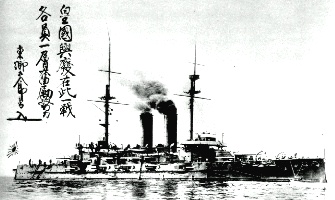
The Japanese fleet now tried to attack and destroy the bedraggled remnants of the Russian fleet, to knock the Russian military out of the east all together. But when a quick victory wasn't forthcoming and the word of approaching Russian reserves arrived, the Japanese commander Togo left the Russians to limp back to a friendly port, and returned to Port Arthur. No, not THAT Togo.


The  reinforcements were the ships of the Russian Baltic fleet, which was sent from the Russian home waters all the way around Europe, Africa, and Asia to reinforce the Russians. They left Russia for the far east, and they made the long journey while the land armies of the Russians and Japanese in Manchuria hunkered down for the winter.


The winter came and went, and when it went the Japanese moved their land forces to attack the town of Mukden, which was at the door of the rest of Manchuria. Both sides dug in, the Japanese attacked, and many soldiers were killed. Eventually the Russians saw that their position was about to be encircled, and retreated. They suffered 90,000 casualties. The Japanese suffered too, but they at least held Mukden for it.


The Japanese Army after Mukden.
(Pic from Wiki)


Now everything was up to the arrival of the Baltic fleet.


The Baltic fleet had a few options. They had to get to the only remaining Russian port: Vladivostok. But there were a few diffenerent ways they could go. One would be to steam around the outside around the Japanese archipelago. That was safer, but it would also give the Japanese more time to consolidate their positions. Another way would be to steam straight through the narrow straits between Japan and Korea. This was the sort of risky but daring move that had the potential to give the Russians enough speed to knock the Japanese off balance and to win the war.


The Japanese had nearly taken the entire pacific theater. So the Russian admiral decided that the necessity was worth the risk and chanced the more dangerous, shorter route. Under the cover of night he doused his fleet's lights and prepared to sneak through. Had he been fully refueled he might have forgone the maneuver and attacked the Japanese fleet outright. After all he but outnumbered and outgunned them. But he needed to fuel up, so one night he started to run the narrows.


All was going well for the Russians, except one little issue. Their safe passage required the cover of darkness. The hospital ships trailing them, in compliance with the rules of war, had to leave their lights on. Japanese fishermen spotted the hospital ships, estimated the rest of the fleet's position, and went to tell admiral Togo. Togo moved swiftly and audaciously into position to cut off and completely obliterate the Russians.


They attacked, and their attack was perfect. All the Russian battleships were sunk in that one battle, as was most of the rest of the convoy. Only three smaller Russian ships escaped to Vladivostok.


There's some pretty cool battle art too.
(Pic from Wiki)


The Japanese had won a crushing victory. The Russians ultimately could have fought on, mustered more forces and ultimately probably won. But the Russian political mood would not accept that. In 1905, the same year the Baltic fleet was destroyed, the forces of Russian society forced the Tsar to cede absolute power and create a proto-parliament. This was partly a result of the humiliating defeat to the Japanese. Maybe Russia had the capacity to continue and to win the war, but the Russian people were unwilling to do so.


And so Russian expansion in the east was halted. For a while, anyway.

Wednesday, July 11, 2012

OMG the Storm (N.C.4)

What Up, Nerds?

1768. Eight years before the penning of the Declaration of Independence. Seven years before the beginning of the American Revolutionary War at Lexington and Concord.


Last time we left North Carolina on the brink of a major upheaval. The whole north part of the state was chafing under the British government's partition of it into the separate Granville District. The whole western part of the state was likewise groaning under the weight of corrupt government officials, courts, and lawyers from Britain and from the east. And in the east Governor William Tryon was building himself an ostentatious opulent mansion. Carolina had suffered like this for years.

And now was the time to do something about it.


They met in the seat of the corrupt North Carolina colonial court system. This was the town of Hillsborough which lay in both the west of the state and in the Granville district, so it was especially badly hit by corruption.


 Sometimes what follows is portrayed as a dry-run for the American Revolution. But it wasn't really. The angry Carolinians who met weren't riled up for the principles of self-government. They weren't interested in the constitutional theories behind the link from taxation to representation. They were just angry about the men who had installed themselves as masters of backwater North Carolina. These men were corrupt and greedy and terrible administrators. Many of the Regulators wouldn't have gave a rat's ass about whether the administrators, were British, American, elected, or appointed. Just as long as they did their jobs correctly.


The anti corruption movement did not precede the revolution in creating an executive council, structured army, and high minded declaration of grievances. If they had written a declaration like that, it would have been pretty short. It would be something like "Fire officials who are corrupt, and don't tax us for the mansion Governor Tryon is building himself." They liked to say they just wanted some modest regulations put on the corrupt government. So they got themselves called the Regulators.


Instead of a Continental Congress the Regulators decided that they'd rather just meet as a colonial mob. No formal structure, no formal leaders. Just a community mob that would meet to f*ck sh*t up. Perhaps the best comparison you could make would be the mobs of the wild west in the 1800's who would meet and dish out cowboy vigilante justice.


So they met in Hillsborough, stormed the court, and carried off the corrupt officials. Next they tried to force the Judge to try and condemn these officials, but he managed to delay for a day and then slip away in the night. They captured the chief corrupt lawyer who was named Edmund Fanning and beat him nearly to death before burning down his house. Next they vandalized the courtroom, pooped in the judge's seat, and sat up the decomposing corpse of an enslaved man at the lawyer's bar. 


For several years the regulators held this kind of sway in the west. There was periodic violence. Petitions were circulated. But the question never really moved towards a solution. In 1770 much of the Granville district also rose up for similar purposes, but Governor Tryon obliterated that uprising with the eastern Militia.


The important thing to understand right now is the Regulator's image problem. In the west of North Carolina it was largely understood that these were just good, reasonable, simple backwoods poor folk who had been exploited by corrupt officials and lawyers. That much was actually pretty true. But in the east the officials weren't corrupt, and they didn't imagine the west was either. The Regulators just looked like wild self-entitled cowboy vigilantes. They were a literal mob of roughnecks who wouldn't accept their government, burned down the house of a "leading" citizen, and pooped in the Judge's seat.


In 1771 Governor Tryon decided enough was enough. He called together a thousand eastern militiamen and organized them into fighting order. And then he set out with his own private army to destroy the Regulators.


The Regulators decided that this would be their chance to teach those easterners that they couldn't just mess with the west. About two thousand of them gathered with guns to whoop Tryon's ass. When the sides met the Regulators showed up in an enormous armed mob of vigilantes with groups of soldiers milling around loosely appointed captains. Tryon's men were arranged in lines of battle, with cannons for support.


Both sides sent demands and conditions for peace. But the Regulators sent over petitions and emissaries without organization or collaboration. Tryon sent over demands, but these were unmet, soon the two armies faced each other over a very short distance.


It was then that the de facto leader of the Regulators left the battlefield. Why? He was a Quaker, a sect of Christianity that involves a strict pacifism. So staring battle in the face the Regulators not had no leadership.


Two Regulators had crossed the lines to try to negotiate peace, but were unsuccessful. Sensing danger, these two had tried to flee. One of them had escaped the easterners' line. The other had been captured by Tryon. And then in a fit of rage at the Regulators Tryon pulled his pistol and executed the captured peacemaker. When Tryon cooled down enough to recognize the implications of what he had done he tried to send over an emissary to cool things down. Enraged about the summary execution of their peace emissary, the Regulators opened fire when they saw one of Tryon's men approaching.


The Battle of Alamance erupted.


At first the Regulators did well. A man named Montgomery had risen up as a temporary battle leader since the Quaker leader had left. And the rebels were able to hide behind trees in the woods and fire at the easterners from there. They even managed to capture one of the governor's three cannon, though they had no ammunition. 


Governor Tryon began to see which way the battle was going and sent another emissary to offer a ceasefire. The Regulators, unfortunately, shot him. At the same time the temporary Regulator battle-leader Montgomery was shot dead. Tryon was enraged by the shooting of his peace emissary and reordered his troops to attack again.


The Regulators were trying to hold out for two hundred more reinforcements that were on on their way. But as Tryon attacked again they began to run out of ammunition. Most of them fled when they ran out of bullets, but a few stayed to fight on. Tryon had the woods they were fighting from lit on fire, and the last of the Regulators fled before their reinforcements could arrive.


In the end the battle had a surprisingly low toll. Out of a thousand easterners and two-thousand regulators, only between twenty four and thirty six people were killed. Nine of the dead were Regulators and between fifteen and twenty seven were easterners. Because he had taken the field Tryon was able to capture thirteen Regulator prisoners and he executed seven of them. Despite a good early performance, the Regulators had left the field and the spoils to Tryon. That was a significant defeat for them and Regulator military power was broken up.


Tryon roved around the captured Regulator territory with his army, burning down regulator homes and exacting even more and higher taxes to pay for his army's supplies from the battle. In the east and in the other colonies people called Governor Tryon a hero, and saw him as the fearless crusher of a bunch of lawless amoral greedy vigilantes. Social order is indeed a very difficult thing to maintain. It is perhaps one of the great underappreciated challenges in social history. And Tryon did enforce order on a fairly unordered place. But whether he was in the right to do is still a question with an ambiguous answer at best.


Many of the defeated Regulators fled further west, into the mountains in present day northeast Tennessee. There they governed themselves and in 1772 created the Republic of Watauga, which operated separately from any British or Colonial government. This republic eventually served as the nucleus for the Free Republic of Franklin after the American Revolution. Franklin applied to join the United States under the Articles of Confederation in 1785 as the first new state to be added, but lost the confirmation vote by two votes in the Continental Congress.


Eventually, Franklin became the nucleus for the State of Tenessee. But it's lost some of it's Regulator ethos since then.


Monday, July 9, 2012

OMG the East is Corrupt (N.C.3)

What Up, Nerds?


So. In 1729 the British Empire partitioned North and South Carolina into separate crown colonies. From that point on North Carolina really began to take off. There was only one little and pretty strange issue.


Back in 1729 when the eight original owners were asked to sell their shares of the Carolina Colony back to the king, one of the eight refused. Owning seven eighths of Carolina was good enough for the king though, so the government went ahead and divided North and South Carolina and started to rule them as royal colonies.


But that eighth owner who didn't sell the land back still wanted his share. For quite a while this man, the Earl of Granville couldn't do anything about the issue. He was too tied up in England where Granville's chief rival had become Prime  Minister and was busily attacking him. Until in 1742 he finally freed himself up to claim his share. The British government agreed to let him take his share out of northern North Carolina. North Carolina was a sizable and populous place, but it lacked the ports and infrastructure to substantively and directly trade with anybody but nearby colonies. Because its trade with England wasn't as important as Virginia's or South Carolina's, the Brits figured they wouldn't miss it too much. Two years later Granville had surveyed his land.


And he took the whole northern part of North Carolina.


This goddamn much.


That was a damn big chunk of the colony to just up and take. But that didn't exactly bother Granville. The government of the rest of the colony was unhappy about Granville's aquisition. The setup of Granville's grant was such that the Earl got all the revenue from taxes and tariffs from the District. But the government of the rest of the state still had to pay for the upkeep and the security of the district, because it was the government. The southern half of the colony was being forced to pay for the business of the whole thing. This made people pretty upset.


Things weren't much better in the north. As time went on the officials the British sent to the District became corrupt and ineffective. Sometimes they'd collect a tax twice and pocket the proceeds, sometime's they wouldn't collect any tax at all from their friends.


When Granville died in 1763 things only got worse. The people were ready to do something about this corrupt government of overseas Englishmen. The storm that had been brewing for the last twenty years was about to break.


But trouble in the District was only half of the foul political weather that was converging over North Carolina.


Since the early 1700's a lot of people had started immigrating to North Carolina. In the beginning they all settled along the coast. Most of these immigrants were English and Scots-Irish. Lots of them were religiously Quaker. Most of them were small farmers. But the richest of them set up plantations. The demands of both groups meant that a significant number of enslaved people got brought in to work on both the small farms and plantations. Slave labor based farming would expand so much that around mid century about a quarter of the population was enslaved black people.


This early American slavery was not as you might imagine it. The image of a large plantation with dozens of enslaved people living in shanties who are forced to labor in the fields all day is, in fact, mostly wrong. There were a few large plantations. But for quite a while during the youth of the colonies the more common experience for slaves and for slavers was the small farm with perhaps one slave on it.


In both North and South Carolina slaves were bought by masters with small holdings. They'd live lives on the rough and tumble frontier. The enslaved man and the master would cohabit. They would be each other's primary companion. They'd cooperate to get the food they needed to survive. And they had to  cooperate on any number of physical tasks, too.


For instance a frontier sawhorse only works with the skilled cooperation of both men on either end. The necessary cooperation and proximity improved the lives of many enslaved people in the period. This "sawhorse equality" did not amount to equality over the law. But it did transform the master and slave into two men alone together in the woods and struggling to survive.


See if YOU can do it on your own.


But over time the number of plantations grew. And with that growth, so too grew chattel slavery. Conditions worsened.


By mid-century and later the eastern part of North Carolina acquired a slave holding elite population. Perhaps because of the relative importance of those elites, the east maintained a fairly efficient and prosperous government.

The settlers in the east weren't all British though. The very important city at New Bern was founded and settled by Germans and Swiss-Germans. Soon this little frontier German burg gre to be North Carolina's biggest and most important town.


And then in the west settlement was a different story too. There were indeed many English settlers of the region. But these were tempered with the addition of Scots-Irish and many more German immigrants who came from Europe via Pennsylvania. They settled mostly small farms. And though slavery sometimes happened there was no real plantation economy. These immigrants soon started to fill the west of the state. By 1752, the population of North Carolina reached 100,000. By 1765 the population was 200,000.


Remember the east of the state, by virtue of its elite position, had secured for themselves a government relatively free of corruption. But the royal and British officials sent into the west had no such elite population to deal with. They abused their powers and made themselves the new elites.


They started to exploit their power in the west in much the same way that the Granville District officials abused their power. They'd extract taxes multiple times. They'd refuse to barter goods as taxes when the west suffered from an acute cash shortage. And then they'd import lawyers to sue and confiscate the farms of those who couldn't pull together the hard cash. The most prominent of them was a man named Edmund Fanning who was caught embezzling but was part of the courts system and so was only fined one penny per guilty charge.


You have to follow laws? How quaint!
(Pic from Wiki)

The westerners couldn't change the tax laws because the eastern elites denied them equal representation in the assembly. When extended droughts hit, the situation worsened and more people still began to lose their farms.


And then the Governor built himself a new mansion at the Capital at New Bern this looked like just one more sign of eastern decadence and exploitation of the west. So many of the westerners refused to pay the tax that would pay for the building. They were itching for a fight, and another political storm started to brew in the west of the state.


In 1768 the poor westerners who opposed the corrupt officials and wanted to lower taxes met in Hillsborough, NC.


And so the storm broke.