Showing posts with label OMG History. Show all posts

Sunday, January 27, 2013

OMG Khazars Part 3


What Up, Nerds?

So we had the Khazar Khaganate. It was a Jewish feudal state that dominated the pontic steppe of south Russia for maybe a hundred to a hundred and fifty years. And for that century and a half, there was peace. But like all things, that would eventually come to an end.

The Khazar peace was built on the same principle that most national stability is based on: overwhelming power. The Khazars could whip any of the other steppe tribes who tried to cause trouble. And to protect their trading wealth, the Khazars did whoop anybody who seemed like they were going to disturb the peace. So nobody in south Russia was willing to make trouble, and things were tranquil.


The Khazar Khaganate at around 850 AD is at the top.
To the south are surrounding Empires, and around Khazaria are the tribes who the Khazars dominated.


And then in the late 800's,there was a revolt among some of the Khazars. The revolt was put down, but the Khazar war drove the Pecheneg tribe off their traditional land in the Khazar orbit. The homeless Pechenegs in turn drove out the Magyars. The Magyars wandered around eastern Europe and stirred up trouble until they eventually settled in modern Hungary and became today's Hungarians.

Still, the first dominos had fallen, and the vassal tribes had begun to slide towards turmoil. More and more tribes were buffeted and forced to move around. The peace and the stability of Khazaria began to break apart. As certainty fell away, the people began to think that the Khazars might not stay in charge forever. And people started to think they could take the Khazars' power for themselves.

Then the Eastern Romans decided to go after the Khazars too. They might as well seize what they could since the Khazars were getting weak. After a war, subterfuge, and a sponsored rebellion the Eastern Roman Empire walked away with the Crimean peninsula.

But the final destruction of the Khazars was coming from another direction.


We start in the late 700's and 800's AD. The Viking age was already in full swing in western Europe. Danish and Norwegian bands were ravaging and settling Ireland, Great Britain, and the Carolingian empire. But the Vikings on the Baltic shore of Scandinavia decided to go the opposite direction. These were the inhabitants of modern Sweden, the Swedes, the Goths, and other less well-known tribes. While the western Scandinavians became famous for pillaging the west, the eastern Scandinavians decided to trade to the east.

The viking way of trade was not what you might call peaceful.

Scandinavian settlers sailed up and down the river systems of Eastern Europe. They searched out good places to both settle and to trade.

Who were they trading with? With the great Eastern Roman Empire and Islamic Caliphate to the south. Then they went back out the Baltic rivers and traded with other Scandinavians as far away as Ireland and Britain. On top of all this, they could extract valued trade goods like amber and furs from the natives of the east European forests.

When they found a good place to build one of their trading towns they would construct well defended commercial forts like Novgorod and Beloozero. Then they struck out from these forts with fire and swords. They subjugated the native peoples and exploited them as best they could to turn an even larger profit. They didn't just take amber and fur, they also took food and slaves.


Rough extent of Scandinavian settlement at the time of initial Rus' colonization.


The Eastern Romans called these trading Vikings the Varangians. But the more famous name of their tribe is the Rus.

This Russian civilization started out relatively weak. We think the early Rus lacked a real central authority, and that as a consequence they were a fairly weak group. The Khazars may have ultimately been the ones who imparted a stable government to them. In any case, a Rus Khaganate eventually arose.

The new Russian Khagans lead several attacks south across the black sea against the Eastern Roman Empire. The Romans were busy fighting off the sudden rise of Islam at the time. So the Russian Vikings got as far as Constantinople without a fight. They took a look at the city's impressive Theodosian Walls, pillaged the suburbs and then headed back to Russia. So Russia became something of an international power. Briefly. 


Well, visiting Constantinople's been nice but I think it's about time we go home.


The Russian ascendancy was short because a rebellion of the native Slavic people took down the Rus Khaganate and drove them back to Sweden in AD 862. The trading forts and viking towns were gone. Russia was almost a very short story.


According to the Russian records, a power vacuum followed the Russian retreat back to the Rus homeland in Sweden. Many Slavic, Baltic, and Finno-Ugric tribes immediately launched wars against and amongst each other. And in the ensuing chaos, a few of the tribes began to wish the old Russian overlords would come back and put things back to the way they used to be. So some of them went to Sweden and asked.


Of course the Rus were invited into Russia.


There were more then a few Rus who were happy to oblige. The possibly mythological viking leader Rurik (this is all still according to those Russian records) assembled a force of fighting traders and settlers and sailed a Russian invasion right back up the rivers into Slavland. When Rurik's troops landed they whooped the fractured native tribes, and they reestablished some of the old Rus cities. The great hub at Novgorod was rebuilt and was made the new Russian capital.

The Russians traded out around the north and west of the Khazar Khaganate, going right back to their old commercial ways, but this time they were less eager to sack and ravage the empires than to trade with them. Arab and Roman traders noted the return of their old trading-partners, and wrote about them. The Arabs particularly called the Rus "smelly and unwashed". But they also thought the Russian men were built spectacularly strong and tall. They had ruddy faces and striking blonde hair. They were, in short, stereotypical vikings.

Plus, like most vikings, they shared a particular sense of style. In western Europe they were considered to be dandies and fops. They combed their hair regularly and bathed significantly more often then the few times a year that the English, French, Spanish, or Italians did. So they didn't seem as barbarous as they might have, and the rival imperials were still happy to trade with them in any case.
Hägar the Hawtness


Around AD 880 prince Oleg of Novgorod succeeded to Rurik's old position as Prince of Russia. He was eager to extend the borders of his domain, so he led his warriors on a campaign south from Novgorod. They conquered native cities like Smolensk, subjected native tribes, and made their way down the Dneiper River. City after city fell, until in 882 he conquered the great city of Kiev and made it his new capital.

After taking Kiev he spent a few years completing the conquest of all the tribes around his new capital and between it and the old capital at Novgorod. Then he led a war against the Eastern Romans with eighty thousand warriors and two thousand ships. There was no conquest, but he managed to impose a tribute upon the Romans, as well as a commercial treaty, before he eventually died in 912.

Prince Oleg's campaign to conquer Kiev.
The view is facing towards western Europe from central Russia.


Oleg's new Kievan Russia would survive his death and even thrive on the land's rich resources and trade. These Russians even began to assimilate to Slavic Culture.

Then Sviatoslav the Brave rose to the throne of Kiev.

Prince Oleg had undoubtedly encroached on Khazaria. Kiev used to be well within the Khazar sphere of influence, and was just across the river from the Khazar Khaganate proper when Khazaria was at its height. But Khazaria had been weakening and retreating, leaving Kiev fairly open to Oleg's conquest. And now the new king Svitoslav had designs on the rest of the country.

Sviatoslav's ultimate objectives were the rich trade routes all the way down the Volga. If the Khazar capital happened to sit on the Volga, that was just too bad.

As his name suggests, Sviatoslav was a Slavicized ruler of Russia, possibly the very first one. He used this identity to his advantage. His first step in taking on Khazaria was to bring all the Khazars' subject Slavs to his banner. He sent out the call and received the backing of the Slavic tribes with only a little bit of difficulty.

He next aimed his warriors at Volga Bulgaria, which was the Bulgarian Kingdom dominating the upper Volga River above Khazaria. The Volga Bulgars had been vassals of the Khazars, but were not overly attached to their masters. After all the Khazars had destroyed their former kingdom of Old Great Bulgaria. Nevertheless, they fought alongside the Khazars. Then when the Khazar-Bulgar coalition lost they began to send Sviatoslav tribute. The Russians had conquered the Upper Volga, and they were ready to head downriver.


The extent of Kievan Russia when Sviatoslav came to the throne is in dark green.
Sviatoslav's campaign to crush the Khazars is marked by the arrows.


But first Sviatoslav made a short detour across Khazaria to the Don river. Here he laid siege to the Khazar Fortress of Sarkel, which lay at the heart of the former great Kingdom of Khazaria. He destroyed old Sarkel but left behind Russian Settlers to establish a new fort, which he called Belaya Vyezha. In the Khazar language, "Sarkel" had meant "White Tower," and Belaya Vyezha was the Slavic translation. Sviatoslav intended to re-settle and remake the pontic steppe to his benefit.

Only one target remained for Prince Sviatoslav.

By the time the Russian army reached the Khazar capital at Itil, the Khazar Army was totally beaten. The Russians attacked the city, and they destroyed it. A visitor to the site a short while later said that after the Russians attacked there was no grape or raisin or leaf on a branch remaining in the city. The capital of the Khazars—the heart of the Khazar Khaganate—was dead.

Sviatoslav had secured the Volga River for Russia, and he headed home after the destruction of Itil. He made a stop to conquer the Ossetians on his way home, but he declined to mop up and occupy every corner of Khazaria. Subsequently small Khazar kingdoms would pull themselves and putter along for a few more years, but would eventually fall prey to Pecheneg and Cuman conquerors.

The Khazars had been great rulers and traders at the height of their power barely a century before. But they had been shaken by war and broken by the Viking Russians in quick succession. And so the story of the second Jewish nation in history came to an end.

Of course, the history of the Russian nation had only just begun.


Sources:
Britannica Online Encyclopedia
Khazaria.com
Larry Gonick's  Cartoon History Series
JewishEncyclopedia.com
JewishVirtualLibrary.com
and of course, Wikipedia


Fun fact: If you google "Rus," you will find a million links to "Toys R' Us." Dammit.

Thursday, August 9, 2012

OMG, Needs More Potemkin!

What Up, Nerds?

1905. The Russo-Japanese war had destroyed two out of three total Russian fleets. The Baltic fleet and the Pacific fleets were bot sitting at the bottom of the Yellow sea. Now only the Black Sea fleet remained.

The Black sea fleet wasn't going to do a thing to help Russia's prospects with war against the Japanese. It was stuck in the Black sea by international treaty. But the men who crewed the fleet weren't. So as the war raged on and more and more Russian sailors from the Pacific and eastern fleets were killed, the Russian government started to transfer all the experienced commanders and crew from the Black Sea Fleet to the east to replace those who died. By the time the Russo-Japanese War ended nearly all the experienced sailors had been moved from the Black Sea Fleet to the Pacific. The Black Sea fleet was manned almost entirely by raw recruits and men passed over by the upper brass.

As such this fleet was made up mostly of men who just didn't really like the military. And they were men who had just seen two-thirds of their country's navy thrown away in a fruitless war for the Tsar's imperial ambitions. They were not the most loyal. There were more than a few revolutionaries on every ship.

And the Russian military's response to revolutionary sentiment? It was the same as its response to everything else: enacting the strictest possible discipline. These revolutionary raw recruits did not react so well to the military's harshness.

In late June of 1905 the revolutionary sailors from the Black Sea fleet met to plan their revolution. They were chafing under the harsh discipline and they were angry about the unpopular war, and that meant to them that the time for revolution had come. They agreed that the sailors of the Battleship Potemkin should be the first to mutiny and begin the overthrow of the Tsar. Once the revolutionaries had taken the Potemkin, the crew of the other ships would follow suit, mutiny, and seize military power all over the Russian coast of the Black Sea.

But then the military authorities found out about their plan. While the Battleship Potemkin was at port they moved in an arrested forty of the lower-lever revolutionaries, as well as one of the ringleaders. They were taken off and summarily shot.


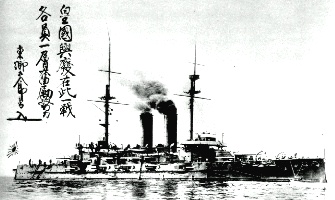
This is the Battleship Potemkin. It was an incredibly formidable boat, one hundred and seven years ago.
(Pic from Wiki)

The Potemkin was ordered to depart port and it sailed to Odessa. At Odessa the Potemkin took on rations, one part of which was a big old portion of maggoty beef. That day when the sailors sat down to eat they noticed the maggots in their Borscht, and refused to eat it. One of the Potemkin's top brass, Lieutenant Giliarovsky, assembled the crew on deck.

He shouted at them and dressed them down, and then he attempted to force them to eat it. About a dozen men complied, but the rest stood firm and refused. Giliarovsky summoned about twenty Marines to deal with these men he saw as mutineers, and all but about thirty of the Potemkin's sailors immediately fled the deck. Among these thirty were secret revolutionaries that the purge on the Potemkin had missed.


Giliarovsky ordered that tarps be lain out on deck. Given theri past experience, the thirty men reckoned the tarps were out so that Giliarovsky could execute them without getting blood all over the decks and then throw them overboard more easily. That wouldn't have been an abnormal punishment for their situation, so you can probably assume they're right. 

Facing their imminent deaths the thirty begged the marines not to  kill them. Meanwhile about thirty other men who had fled the deck saw what was happening and acted fast. They stormed the armory and then they seized the signal room and the engine room. That second group of thirty men came out on deck very quickly, and at that point the marines declined to shoot anybody.

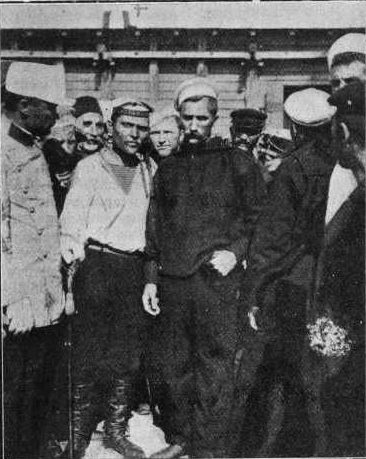
Lieutenant Giliarovsky was furious. He decided to take matters into his own hands. So he pulled his gun and shot one of the revolutionaries, Artillery Quartemaster Grigory Vakulinchuk. He ordered the marines to attack again, but the marines preferred not to die and ran away instead. The thirty armed sailors took the opportunity to shoot Giliarovsky dead. They moved like lightning as the ship's officers fled. They seized the Potemkin, and then took the torpedo boat that accompanied her, the Ismail. When the dust cleared they had killed seven officers and arrested twelve more. They set up a revolutionary committee on board with a man named Afanasi Matushenko as chairman. Matushenko had been an NCO and a political activist before the uprising, and now he took command of the tiny two-ship revolutionary fleet.


But the lack of Mustache was the most revolutionary thing about him.
(Pic from Wiki)

By ten o'clock that night the revolutionary battleship Potemkin steamed into the port at Odessa with one more new red flag and with one less old picture of the Tsar.

The imperial government at Odessa was already having some problems with revolutionaries. A general strike had been called across the city against the government's wishes. The arrival of a revolutionary battleship in port helped the imperials in no way. The strikers immediately approached the sailors and asked for their help to storm the armory and take over the city. By acting in this way the strikers figured they could extend the Potemkin's revolution to the land and use their armed workers as a land army in conjunction with the revolutionary fleet. Then they could support each others forces and take down the weakened Tsarist state.

That actually been had been the revolutionary sailors' original plan before the mutiny, but confusion and division between the sailors and these particular strikers quickly started to drive the sailors away. In the end the crewmen of the Potemkin were unwilling to commit their few men to a risky storming of the armory, and the assault never happened.

Instead the body of Quartermaster Vakulinchuk, who had been the man shot by Lieutenant Giliarovsky, was taken off the ship to be given a "state" funeral. The revolutionaries proceeded to carry Vakulinchuk's body up what is now know as the Potemkin stairs, in Odessa.

Ten thousand Odessan workers had massed to see the funeral.


Even on stairs that big, ten-thousand would have been a crowd.
(Pic from Wiki)

Three imperial port officials and fifty dismounted Cossacks saw this as their chance to disrupt the revolutionaries, and they attacked the funeral.  Apparently they didn't consider that they were fifty-three guys attacking ten thousand guys and also a battleship.The imperials were driven off. But the sailors still refused to go on the attack. Revolutionaries and the government started to fight in open battles across the whole city, and there were over twelve hundred casualties. The next day the Potemkin fired two shells into the section of the city that housed the military headquarters. Those shells killed only one man, and he was a civilian. Meanwhile the government and the workers continued to clash, and many people died.

The imperial government, fearing full scale revolution, sent in army reinforcements to crush the revolt in Odessa, and they sent the bulk of the rest of the black sea fleet to destroy or capture the Potemkin. When word of this arrived, the sailors were undaunted. The Potemkin steamed out to meet the imperial fleet near Tendra Island. The forces met and the Potemkin headed straight for the middle of the other fleet.


And the Potemkin refused to fire a single shot.

Seemingly miraculously, every single other ship refused to fire too. The crews of all the ships refused to attack the revolutionaries, men who they saw as their comrades. And as The Potemkin pulled away she had been joined by the Battleship Georgii Pobedonosets, which had just risen up in a bloodless mutiny. The revolutionary ships headed back to Odessa and left the rest of the fleet to puzzle over their gunners' sudden ineptitude.

But shortly after the Potemkin, Ismail, and Georgii Pobedonosets  began to head back to Odessa. Things went suddenly south on the new ship. The Potemkin had sent the Georgii one of its chief revolutionaries in order to maintain unity in the fleet. But that representative decided to rebel back to the imperial Government. He convinced the crew of the Georgii that the Potemkin was planning to arrest all of the NCO's and distinguished seamen, despite the fact that the head of the revolution, Matushenko, was himself an NCO. Then, after clearing out all the officers the Potemkin was supposed to make a full attack on the people of Odessa, where the crew of the Georgii was from. They were supposed to attack Odessa despite all of their previously relatively friendly interactions. So the officers of the Georgii Pobedonosets seized control of the ship, grounded her, and then before fled.

Again, two more ships mutinied and joined with the Potemkin too. But they were quickly either captured or turned against the revolution like the Georgii had been. So the Potemkin and her escort, the Ismail, remained alone in revolution.


You'll probably need this.


The Potemkin was starting to run short of supplies and steamed south to Constanța in Romania. But the port officials in Constanța feared the relative the might of the enormous Russian Empire. So the Romanians refused to sell them any goods. Unwilling to seize anything from the innocent Romanians, the Potemkin went to Feodosiya, back in Russia. Feodosiya was much more accommodating, and gave them everything they needed. Everything but coal and fresh water, that is.

The Potemkin needed water and coal, so it sent out a small force to seize some nearby imperial coal barges. The Russian army was on the prowl though. The imperials found the revolutionaries and killed most of the coal-finding force.

The Potemkin, desperately low on water and coal, sailed back to Constanța. The Romanian port officials weren't willing to give them the necessary supplies. And so, starved for coal and water and without having fought a single sea battle, the crew of the Potemkin determined that they were beaten. They let some counter-revolutionaries on their accompanying boat Ismail take that ship back to Russia. And then the Potemkin itsself was scuttled and half-sunk at Constanța. They had been defeated with hardly any clash of arms. But when the revolutionary sailors headed ashore, the Romanian crowd still cheered them.

The ship herself was quickly dragged back up, and returned to Russia, which renamed her. She continued to serve until 1919, when she was scuttled by anti-revolutionaries who wanted to keep her out of the Bolsheviks' hands.

Most of the sailors remained in Romania until the Russian Revolution. Most of the few who who returned before then were killed or imprisoned. The leader Matushenko himself returned to Russia under a promise of amnesty in 1907. His amnesty was immediately disregarded and he was promptly executed.

So what sort of legacy did the Potemkin's little revolution have?

The last surviving crew member died in 1987, in Ireland. He had made his way to the British Isles, where he had met Lenin, and eventually set up Beshoff's Fish and Chips in Dublin.

Omnomnomnom.
(Pic from Beshoff's)


But the revolution of 1917 saw the Battleship Potemkin's rebellion as a precedent. And 1905, it helped other Russian revolutionaries force some of the lesser reforms of the same year, like the Duma (similar to a parliament). In the end, the Potemkin probably helped speed the revolution, but not as much as the sailors would have liked. And of course even after some initial success the Russian Revolution itself would eventually fall to totalitarian control. But for the time the Potemkin rebellion wasn't a bad try at forcing social change.

And that's all the Potemkin you're getting for now.

Wednesday, July 25, 2012

OMG Togo Versus the Rooskies

What Up Nerds?


My wonderful brilliant beautiful girlfriend has been traveling with her family eastwards across Siberia. She traveled very quickly right across Russia towards the pacific. I can't help but think about the days when Russia its self was charging across Siberia towards the sea and beyond. Russian expansion is some of the most remarkable in western history. And the inevitable clash that expansion caused is likewise remarkable. It resulted in one of the most interesting battles of east meet west I know of.


About a hundred and ten years before today the Russian empire was enormous. It spanned most of northern Eurasia and included much more of Europe than does present day Russia. And it was still expansionist. In the south it had, with the help of a few well chosen allies, essentially forced the concession of Port Arthur from China. And Russia had also started making inroads into Manchuria and northern Korea. The other empire that was much closer to and that was expanding into this territory was Japan.


The Russian Empire in green, Port Arthur in red, disputed Manchuria and northern Korea in pink.
(base image from Wiki)
The thirty seven year old Japanese Empire didn't think it would be able to take on Russia and any of her European allies in a war. So at first Japan offered the expansionist Russians a partition of the disputed territory, giving Russia Manchuria and giving Japan northern Korea. This wouldn't have been too bad a deal for Russia.


The Russians and Japanese negotiated on this basis, but the Russians were unwilling to consent, believing themselves to have the stronger military position. But then the Japanese secured an alliance with the British that ensured the Brits would fight off any Russian allies who joined a potential Russo-Japanese War. With this alliance the Japanese saw their position grow much stronger. So when Russia once again rejected their offer to split the disputed territory, Japan was willing to fight it out.


At this point the Japanese thought they could probably win an at least short-term victory and could  use that victory to extract concessions from Russia. The Russians felt certain they would win too, and Tsar Nicholas is rumored to have wanted war because he thought it could ignite Russian patriotic fervor.


On February 8, 1904 the Japanese declared war, and launched an attack on the Russian fleet at Port Arthur that very night. Because of how bad communication was, that was actually before the declaration of war had even reached Moscow and the Tsar. That meant that news of the Japanese attack came before the news of the war declaration. The Japanese hit the two biggest Russian battleships hard in the first attack and they injured the rest of the fleet too. Still, none of the big ships were sunk, so there was still very much a question of who would win. The Russians weren't beat by a long shot, and they dug in at their port. The Japanese used this chance to blockade the besieged Russians and to seize Korea. They landed at Inchon and quickly overran the rest of the country.


After taking Korea, the Japanese pressed on towards Port Arthur. The Japanese did their best to effect a lightning fast war that could be won before Russian reinforcements arrived in great numbers. The Russians, by contrast, tried only to slow the Japanese down as much as possible and to exact as high a casualty toll on the Japanese as possible. They succeeded at their second goal. The Japanese had completely surrounded and besieged port Arthur before too long, but they had suffered stunningly high losses. And Russia still had many more soldiers coming.


The battles were incredibly hard-fought. Some sources portray these battles as a precursor
 to the immensely  deadly  trench warfare battles of WWI. It's not a bad comparison.
(pic from Wiki)

The Japanese besieging Port Arthur sunk almost the whole Russian Pacific fleet in fairly short order by using offensive mine-laying tactics. The Russians soon hit the Japanese back with offensive mining tactics but the Japanese fleet was much closer at hand, and could more easily replenish their losses. Even so, the Russians sank a third of the Japanese battleships. The Russian position at Port Arthur was hit hard, but the battle for it was hurting the Japanese much worse than it hurt the Russians. The Japanese were not in a great position. The Tsar, perhaps not happy, was at least content.


And then the Russian commander surprised everyone on both sides of the war by surrendering. He had decided that since the fleet had been destroyed, the purpose for defending Port Arthur had been lost. So even though the Russian Empire was doing very well off of the defense of Port Arthur, he surrendered. The Japanese were ecstatic. The Russians were furious.


The Japanese fleet now tried to attack and destroy the bedraggled remnants of the Russian fleet, to knock the Russian military out of the east all together. But when a quick victory wasn't forthcoming and the word of approaching Russian reserves arrived, the Japanese commander Togo left the Russians to limp back to a friendly port, and returned to Port Arthur. No, not THAT Togo.


The  reinforcements were the ships of the Russian Baltic fleet, which was sent from the Russian home waters all the way around Europe, Africa, and Asia to reinforce the Russians. They left Russia for the far east, and they made the long journey while the land armies of the Russians and Japanese in Manchuria hunkered down for the winter.


The winter came and went, and when it went the Japanese moved their land forces to attack the town of Mukden, which was at the door of the rest of Manchuria. Both sides dug in, the Japanese attacked, and many soldiers were killed. Eventually the Russians saw that their position was about to be encircled, and retreated. They suffered 90,000 casualties. The Japanese suffered too, but they at least held Mukden for it.


The Japanese Army after Mukden.
(Pic from Wiki)


Now everything was up to the arrival of the Baltic fleet.


The Baltic fleet had a few options. They had to get to the only remaining Russian port: Vladivostok. But there were a few diffenerent ways they could go. One would be to steam around the outside around the Japanese archipelago. That was safer, but it would also give the Japanese more time to consolidate their positions. Another way would be to steam straight through the narrow straits between Japan and Korea. This was the sort of risky but daring move that had the potential to give the Russians enough speed to knock the Japanese off balance and to win the war.


The Japanese had nearly taken the entire pacific theater. So the Russian admiral decided that the necessity was worth the risk and chanced the more dangerous, shorter route. Under the cover of night he doused his fleet's lights and prepared to sneak through. Had he been fully refueled he might have forgone the maneuver and attacked the Japanese fleet outright. After all he but outnumbered and outgunned them. But he needed to fuel up, so one night he started to run the narrows.


All was going well for the Russians, except one little issue. Their safe passage required the cover of darkness. The hospital ships trailing them, in compliance with the rules of war, had to leave their lights on. Japanese fishermen spotted the hospital ships, estimated the rest of the fleet's position, and went to tell admiral Togo. Togo moved swiftly and audaciously into position to cut off and completely obliterate the Russians.


They attacked, and their attack was perfect. All the Russian battleships were sunk in that one battle, as was most of the rest of the convoy. Only three smaller Russian ships escaped to Vladivostok.


There's some pretty cool battle art too.
(Pic from Wiki)


The Japanese had won a crushing victory. The Russians ultimately could have fought on, mustered more forces and ultimately probably won. But the Russian political mood would not accept that. In 1905, the same year the Baltic fleet was destroyed, the forces of Russian society forced the Tsar to cede absolute power and create a proto-parliament. This was partly a result of the humiliating defeat to the Japanese. Maybe Russia had the capacity to continue and to win the war, but the Russian people were unwilling to do so.


And so Russian expansion in the east was halted. For a while, anyway.

Wednesday, July 18, 2012

OMG Gage

What Up, Nerds?

So on Friday my family found out that my mother had brain cancer. It was in her frontal lobe. Yesterday she had successful surgery to remove it. Though she'll be in for chemo and radiation for a while yet. Relief.

When the doctors asked her what year it was before the surgery, she said 2013. She had other difficulties keeping time straight. Apparently that's one thing your front brain keeps track of. But they opened up her brain, removed the tumor, and she's fine with time now.

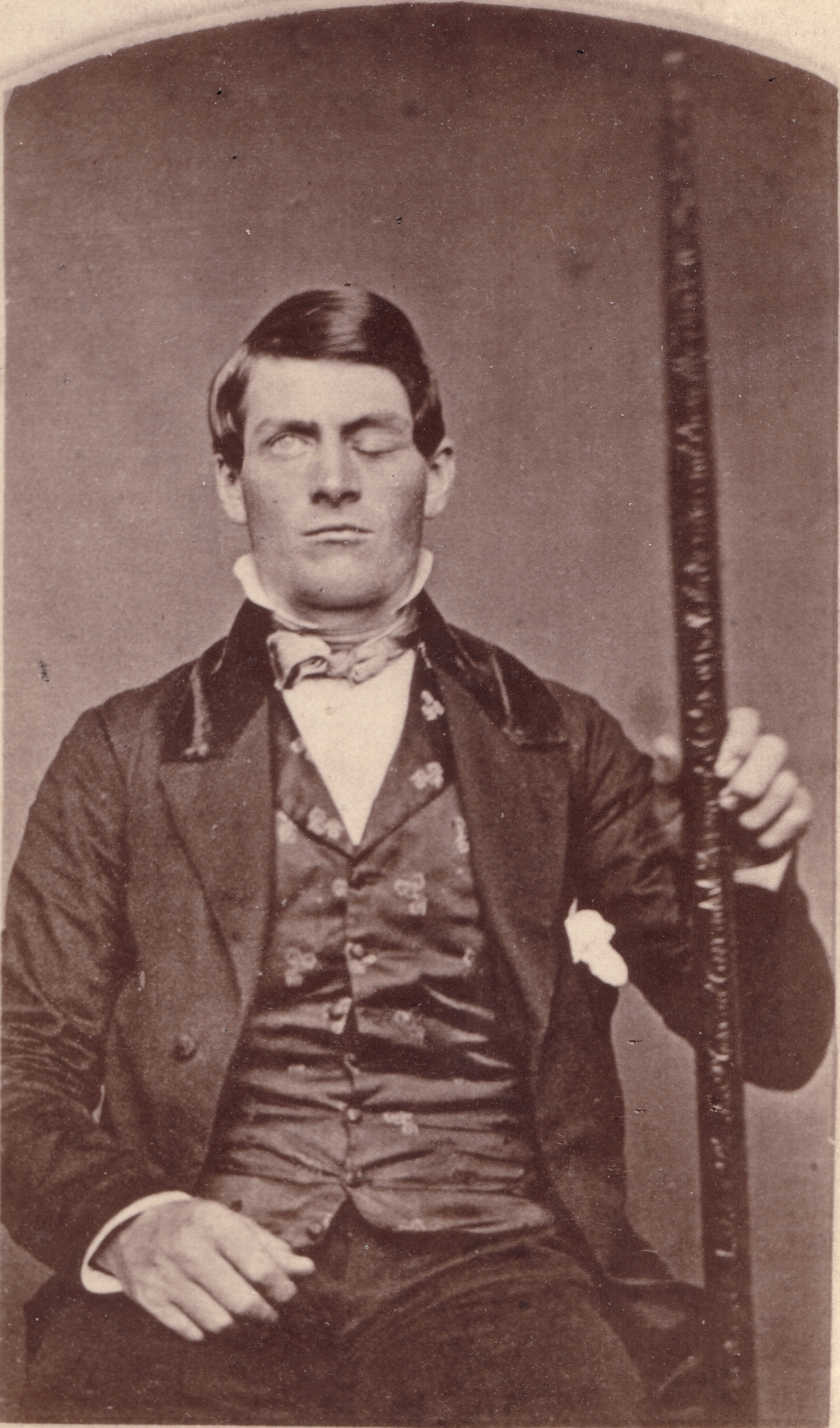
This is the famous story of Phineas Gage, who was one of the first recorded cases of having his brain opened. He was in fact worse with time afterwards.


It was 1848. Vermont. Phineas was the foreman of a crew that was preparing railroad grade. They filled boreholes with gunpowder and blew them up to explode the railroad bed into the right shape.

This was before they invented work-place safety. One day while Gage was compaction it down, the gunpowder exploded. The blast shot the the yard long and inch and a half wide steel tamping spike right through Gage's head. Through his frontal lobe. Bam. Gage collapsed immediately.

Ka Chunk.
(Pic from Wiki)


The spike landed eighty feet away, brains and blood all over it.

A few minutes later Gage just got up, probably swore a lot, walked over to a nearby cart, and rode on it back into town.

There wasn't even a doctor in town when he got there. So they sent for one, and in the meantime Gage sat himself down and started telling anybody who would listen about how he had just shot a big metal spike through his brain. He got a pretty big crowd to listen.

No really, right through the top.
(Pic from Wiki)

When the doctor came he saw Gage had some sort of injury, but he was sure the man was lying out his ass about what it was and how he had gotten it. After a minute of Gage and the doctor arguing, Gage started to throw up and half a cup of his brains fell out. Suddenly the doctor believed Gage.

An hour later a better doctor showed up. Gage told him "I hope this injury isn't too bad."  The doctor couldn't believe Gage was alive.

Gage declined quickly after that. He spent the next few weeks in near coma, with a coffin just outside of his house for when he died. Because he was clearly going to die. Because he still had a hole clean through his head. But then after a few weeks he got up and started walking around. He got out and walked to see his friends and family every day that he could escape from his doctor's care. And a month after that he was healed enough to live life normally. His main challenge after this point was escaping the care of his doctor.

He looked a little funny now, he had a scar and a depression in his head, couldn't use his left eye, and had a paralyzed left side of the face. But apart from that he was physically fine.

Walk it off.
(Pic from Wiki)

Gage lived a fairly normal life after that, until he died "of convulsions" a few years later. After the doctors heard he was dead, they got permission, dug him up, and took his head off to study.

But what about Gage's mental health? Well, that's where the problems were. After his accident, Gage became kind of a dick. Just a douchebag in general. Not a pleasant person. Besides that he lost many of his adult reasoning abilities. And what else? He couldn't keep an appointment or keep time straight. That's about it.

And then after a few years he got better, less of a dick. Parts of his brain took up the slack, and he returned to normal, more or less.

And that is how we know why my mother thought it was 2013. Or maybe she just wasn't paying attention when they asked her. Either way.

Wednesday, July 11, 2012

OMG the Storm (N.C.4)

What Up, Nerds?

1768. Eight years before the penning of the Declaration of Independence. Seven years before the beginning of the American Revolutionary War at Lexington and Concord.


Last time we left North Carolina on the brink of a major upheaval. The whole north part of the state was chafing under the British government's partition of it into the separate Granville District. The whole western part of the state was likewise groaning under the weight of corrupt government officials, courts, and lawyers from Britain and from the east. And in the east Governor William Tryon was building himself an ostentatious opulent mansion. Carolina had suffered like this for years.

And now was the time to do something about it.


They met in the seat of the corrupt North Carolina colonial court system. This was the town of Hillsborough which lay in both the west of the state and in the Granville district, so it was especially badly hit by corruption.


 Sometimes what follows is portrayed as a dry-run for the American Revolution. But it wasn't really. The angry Carolinians who met weren't riled up for the principles of self-government. They weren't interested in the constitutional theories behind the link from taxation to representation. They were just angry about the men who had installed themselves as masters of backwater North Carolina. These men were corrupt and greedy and terrible administrators. Many of the Regulators wouldn't have gave a rat's ass about whether the administrators, were British, American, elected, or appointed. Just as long as they did their jobs correctly.


The anti corruption movement did not precede the revolution in creating an executive council, structured army, and high minded declaration of grievances. If they had written a declaration like that, it would have been pretty short. It would be something like "Fire officials who are corrupt, and don't tax us for the mansion Governor Tryon is building himself." They liked to say they just wanted some modest regulations put on the corrupt government. So they got themselves called the Regulators.


Instead of a Continental Congress the Regulators decided that they'd rather just meet as a colonial mob. No formal structure, no formal leaders. Just a community mob that would meet to f*ck sh*t up. Perhaps the best comparison you could make would be the mobs of the wild west in the 1800's who would meet and dish out cowboy vigilante justice.


So they met in Hillsborough, stormed the court, and carried off the corrupt officials. Next they tried to force the Judge to try and condemn these officials, but he managed to delay for a day and then slip away in the night. They captured the chief corrupt lawyer who was named Edmund Fanning and beat him nearly to death before burning down his house. Next they vandalized the courtroom, pooped in the judge's seat, and sat up the decomposing corpse of an enslaved man at the lawyer's bar. 


For several years the regulators held this kind of sway in the west. There was periodic violence. Petitions were circulated. But the question never really moved towards a solution. In 1770 much of the Granville district also rose up for similar purposes, but Governor Tryon obliterated that uprising with the eastern Militia.


The important thing to understand right now is the Regulator's image problem. In the west of North Carolina it was largely understood that these were just good, reasonable, simple backwoods poor folk who had been exploited by corrupt officials and lawyers. That much was actually pretty true. But in the east the officials weren't corrupt, and they didn't imagine the west was either. The Regulators just looked like wild self-entitled cowboy vigilantes. They were a literal mob of roughnecks who wouldn't accept their government, burned down the house of a "leading" citizen, and pooped in the Judge's seat.


In 1771 Governor Tryon decided enough was enough. He called together a thousand eastern militiamen and organized them into fighting order. And then he set out with his own private army to destroy the Regulators.


The Regulators decided that this would be their chance to teach those easterners that they couldn't just mess with the west. About two thousand of them gathered with guns to whoop Tryon's ass. When the sides met the Regulators showed up in an enormous armed mob of vigilantes with groups of soldiers milling around loosely appointed captains. Tryon's men were arranged in lines of battle, with cannons for support.


Both sides sent demands and conditions for peace. But the Regulators sent over petitions and emissaries without organization or collaboration. Tryon sent over demands, but these were unmet, soon the two armies faced each other over a very short distance.


It was then that the de facto leader of the Regulators left the battlefield. Why? He was a Quaker, a sect of Christianity that involves a strict pacifism. So staring battle in the face the Regulators not had no leadership.


Two Regulators had crossed the lines to try to negotiate peace, but were unsuccessful. Sensing danger, these two had tried to flee. One of them had escaped the easterners' line. The other had been captured by Tryon. And then in a fit of rage at the Regulators Tryon pulled his pistol and executed the captured peacemaker. When Tryon cooled down enough to recognize the implications of what he had done he tried to send over an emissary to cool things down. Enraged about the summary execution of their peace emissary, the Regulators opened fire when they saw one of Tryon's men approaching.


The Battle of Alamance erupted.


At first the Regulators did well. A man named Montgomery had risen up as a temporary battle leader since the Quaker leader had left. And the rebels were able to hide behind trees in the woods and fire at the easterners from there. They even managed to capture one of the governor's three cannon, though they had no ammunition. 


Governor Tryon began to see which way the battle was going and sent another emissary to offer a ceasefire. The Regulators, unfortunately, shot him. At the same time the temporary Regulator battle-leader Montgomery was shot dead. Tryon was enraged by the shooting of his peace emissary and reordered his troops to attack again.


The Regulators were trying to hold out for two hundred more reinforcements that were on on their way. But as Tryon attacked again they began to run out of ammunition. Most of them fled when they ran out of bullets, but a few stayed to fight on. Tryon had the woods they were fighting from lit on fire, and the last of the Regulators fled before their reinforcements could arrive.


In the end the battle had a surprisingly low toll. Out of a thousand easterners and two-thousand regulators, only between twenty four and thirty six people were killed. Nine of the dead were Regulators and between fifteen and twenty seven were easterners. Because he had taken the field Tryon was able to capture thirteen Regulator prisoners and he executed seven of them. Despite a good early performance, the Regulators had left the field and the spoils to Tryon. That was a significant defeat for them and Regulator military power was broken up.


Tryon roved around the captured Regulator territory with his army, burning down regulator homes and exacting even more and higher taxes to pay for his army's supplies from the battle. In the east and in the other colonies people called Governor Tryon a hero, and saw him as the fearless crusher of a bunch of lawless amoral greedy vigilantes. Social order is indeed a very difficult thing to maintain. It is perhaps one of the great underappreciated challenges in social history. And Tryon did enforce order on a fairly unordered place. But whether he was in the right to do is still a question with an ambiguous answer at best.


Many of the defeated Regulators fled further west, into the mountains in present day northeast Tennessee. There they governed themselves and in 1772 created the Republic of Watauga, which operated separately from any British or Colonial government. This republic eventually served as the nucleus for the Free Republic of Franklin after the American Revolution. Franklin applied to join the United States under the Articles of Confederation in 1785 as the first new state to be added, but lost the confirmation vote by two votes in the Continental Congress.


Eventually, Franklin became the nucleus for the State of Tenessee. But it's lost some of it's Regulator ethos since then.


Monday, July 9, 2012

OMG the East is Corrupt (N.C.3)

What Up, Nerds?


So. In 1729 the British Empire partitioned North and South Carolina into separate crown colonies. From that point on North Carolina really began to take off. There was only one little and pretty strange issue.


Back in 1729 when the eight original owners were asked to sell their shares of the Carolina Colony back to the king, one of the eight refused. Owning seven eighths of Carolina was good enough for the king though, so the government went ahead and divided North and South Carolina and started to rule them as royal colonies.


But that eighth owner who didn't sell the land back still wanted his share. For quite a while this man, the Earl of Granville couldn't do anything about the issue. He was too tied up in England where Granville's chief rival had become Prime  Minister and was busily attacking him. Until in 1742 he finally freed himself up to claim his share. The British government agreed to let him take his share out of northern North Carolina. North Carolina was a sizable and populous place, but it lacked the ports and infrastructure to substantively and directly trade with anybody but nearby colonies. Because its trade with England wasn't as important as Virginia's or South Carolina's, the Brits figured they wouldn't miss it too much. Two years later Granville had surveyed his land.


And he took the whole northern part of North Carolina.


This goddamn much.


That was a damn big chunk of the colony to just up and take. But that didn't exactly bother Granville. The government of the rest of the colony was unhappy about Granville's aquisition. The setup of Granville's grant was such that the Earl got all the revenue from taxes and tariffs from the District. But the government of the rest of the state still had to pay for the upkeep and the security of the district, because it was the government. The southern half of the colony was being forced to pay for the business of the whole thing. This made people pretty upset.


Things weren't much better in the north. As time went on the officials the British sent to the District became corrupt and ineffective. Sometimes they'd collect a tax twice and pocket the proceeds, sometime's they wouldn't collect any tax at all from their friends.


When Granville died in 1763 things only got worse. The people were ready to do something about this corrupt government of overseas Englishmen. The storm that had been brewing for the last twenty years was about to break.


But trouble in the District was only half of the foul political weather that was converging over North Carolina.


Since the early 1700's a lot of people had started immigrating to North Carolina. In the beginning they all settled along the coast. Most of these immigrants were English and Scots-Irish. Lots of them were religiously Quaker. Most of them were small farmers. But the richest of them set up plantations. The demands of both groups meant that a significant number of enslaved people got brought in to work on both the small farms and plantations. Slave labor based farming would expand so much that around mid century about a quarter of the population was enslaved black people.


This early American slavery was not as you might imagine it. The image of a large plantation with dozens of enslaved people living in shanties who are forced to labor in the fields all day is, in fact, mostly wrong. There were a few large plantations. But for quite a while during the youth of the colonies the more common experience for slaves and for slavers was the small farm with perhaps one slave on it.


In both North and South Carolina slaves were bought by masters with small holdings. They'd live lives on the rough and tumble frontier. The enslaved man and the master would cohabit. They would be each other's primary companion. They'd cooperate to get the food they needed to survive. And they had to  cooperate on any number of physical tasks, too.


For instance a frontier sawhorse only works with the skilled cooperation of both men on either end. The necessary cooperation and proximity improved the lives of many enslaved people in the period. This "sawhorse equality" did not amount to equality over the law. But it did transform the master and slave into two men alone together in the woods and struggling to survive.


See if YOU can do it on your own.


But over time the number of plantations grew. And with that growth, so too grew chattel slavery. Conditions worsened.


By mid-century and later the eastern part of North Carolina acquired a slave holding elite population. Perhaps because of the relative importance of those elites, the east maintained a fairly efficient and prosperous government.

The settlers in the east weren't all British though. The very important city at New Bern was founded and settled by Germans and Swiss-Germans. Soon this little frontier German burg gre to be North Carolina's biggest and most important town.


And then in the west settlement was a different story too. There were indeed many English settlers of the region. But these were tempered with the addition of Scots-Irish and many more German immigrants who came from Europe via Pennsylvania. They settled mostly small farms. And though slavery sometimes happened there was no real plantation economy. These immigrants soon started to fill the west of the state. By 1752, the population of North Carolina reached 100,000. By 1765 the population was 200,000.


Remember the east of the state, by virtue of its elite position, had secured for themselves a government relatively free of corruption. But the royal and British officials sent into the west had no such elite population to deal with. They abused their powers and made themselves the new elites.


They started to exploit their power in the west in much the same way that the Granville District officials abused their power. They'd extract taxes multiple times. They'd refuse to barter goods as taxes when the west suffered from an acute cash shortage. And then they'd import lawyers to sue and confiscate the farms of those who couldn't pull together the hard cash. The most prominent of them was a man named Edmund Fanning who was caught embezzling but was part of the courts system and so was only fined one penny per guilty charge.


You have to follow laws? How quaint!
(Pic from Wiki)

The westerners couldn't change the tax laws because the eastern elites denied them equal representation in the assembly. When extended droughts hit, the situation worsened and more people still began to lose their farms.


And then the Governor built himself a new mansion at the Capital at New Bern this looked like just one more sign of eastern decadence and exploitation of the west. So many of the westerners refused to pay the tax that would pay for the building. They were itching for a fight, and another political storm started to brew in the west of the state.


In 1768 the poor westerners who opposed the corrupt officials and wanted to lower taxes met in Hillsborough, NC.


And so the storm broke.

Friday, June 29, 2012

OMG Xanadu

What Up, Nerds?


The great Khan of the Mongols—Mongke—had just died while leading the invasion of the Song dynasty in south China. 


The old Khan was dead and that meant the Mongols were without an leader. The way they usually chose a new leader was to have all the political officials, military officials, and important descendants of Genghis Khan meet together and elect a new Khan.

Kublai, being an ambitious sort of guy, thought that maybe he should become the new Mongol leader.  In order to do that he would need the freedon to devote more attention and resources to Mongol Politics than to the war against the Song. So he negotiated a peace treaty where he wouldn't attack the Song and the Song would pay him off with a heaping pile of silk, and then he headed back north to Mongolia. A pretty good peace, if you ask me.

When Kublai arrived up north he got some bad news. Most of the eligible voters and most of the Mongols thought that his uncle Ariq should be Khan. Only Kublai and his brother Hulagu thought Kublai was the better choice. So Ariq had called a meeting in the Mongol Capital at Karakorum. The meeting had elected him, and he had already been crowned Khan. So Kublai had been beat before the game even began and he returned to the south to restart the war with the Song.

Karakorum. Kind of a dinky little town..
(Pic from Wiki)


Nahhh not really. When Kublai found out he shrugged and said "f*ck this, I own half of China!" He called his own meeting with hand-picked but politically unrepresentative "representatives" from all the important Mongol tribes and he got them to "elect" him Khan. So now there were two Khans, except that Kublai's claim was full of bullsh*t.

But when you own half of China you can get away with a little bull.

Kublai drew up his armies.

In the south, several of the generals who he'd had fighting the Song declared that they were loyal to Ariq. Ariq also held the loyalty of central Mongolia and of the Mongol domain in Russia. Kublai had north China and the loyalty of his brother Hulagu who owned Iran and Iraq. Kublai quickly started to crush Ariq's generals on the border with the Song.


After dealing with Ariq's men to his south Kublai marched his own army straight into Mongolia. He made a beeline for Ariq, who was only too happy to humor Kublai. But when the two armies met Kublai whupped Ariq's army hard. Ariq's primary general and strategist was killed, and Ariq fled. Ariq had bet too much on that battle and he had to disappear for a long while to bring his army back up to fighting shape. Whiae Ariq was busy Kublai moved to attack and capture the Mongol capital at Karakorum. Ariq recovered, and the two armies dueled in the field for several years. Ariq briefly retook Karokorum, but not for long, and the city was mostly destroyed in the fighting.


Over the course of several more years of warfare back and forth, Ariq's army wore down while Kublai just drew on the seemingly infinite strength of China to replentish his own forces. This meant that more and more Mongols started to see the way things were headed and they defected to Kublai. Eventually enough bigwigs like the governor Ariq himself had appointed over central Asia defected, and the war started to wind down

Ariq had to give up and he surrendered to Kublai. Kublai called a new meeting at his capital of Xanadu to confirm his as chief of the Mongols. At the meeting he "forgave" his uncle for totally being the one who illegally usurped Kublai's completely legitimate Khan status, and executed all of Ariq's followers.

When they heard about this, the Mongol ruler of Russia and also Kublai's own brother Hulagu who ruled Iraq and Iran got a little uncomfortable. They sent word that they agreed Kublai was Khan, but didn't come to Kublai's meeting and started to drift away from the central Mongol state. Soon war between the two Mongol provinces broke out. This was no surprise, since that war had been brewing between them for a while. Kublai did his best to force his control over the whole empire, but his rule was unstable and revolts sprung up all over. He would eventually put them down, but things were still shaky.

In the mean time, he was able to turn his attention back to south China. Kublai attacked the Song and started the war back up with an enormous victory, where the Mongols crushed many of the Song armies and where they captured a hundred Song ships. The Mongols started an enormous advance into the heart of the Song south, but were stopped at the twin cities of Xiangyang and Fencheng north of the Yangtze river. The cities resisted a massive siege, and both sides poured massive resources into this one fight. The sided sent fleets of thousands and thousands of ships down the river between the cities and brought up many siege weapons, including explosive devices called "thunder crash bombs" which still sounds like a racist stereotype to me, even though it is historical.

Xiangyang is on the northern edge of central Song territory.


After years and years of struggle at the twin cities, the Song defenders let political infighting get the better of them. Fencheng was stormed and completely butchered and Xiangyang surrendered quickly after that. As soon as the cities fell, the Song sent their own fleet of thousands of ships up the river the cities lay on to take them back. Song forces spent five years attacking before the Mongols finally drove them back.


The Mongols then pressed south and after a very long fight they made it to the Yangtze river. There they built an enormous fleet to use to conquer the rest of Song territory.

It would not be an easy fight. The Song had their own fleet which was also full of thousands and thousands of ships. And the Song ships were technologically advanced too, using paddle wheels and gunpowder to take on the Mongols. The sides fought on and gained and lost ground for years and years. Little progress was made. Everyone died in enormous numbers.

Paddleboats: apparently cutting edge technology.
(Pic from Wiki)


Slowly, Mongol power started to get the edge. As they realized this was the case, the Song districts started to surrender to the Mongols. The as the last districts outside the capital fell, the Song child-emperor saw how the die had fallen and resigned.


After so many years of war though, the hard core Song supporters simply could not stand to let the mongols win. So they took the emperor's younger brothers, enthroned them, and brought them to fight on in Hong Kong and the islands in the very far south of China. The mongols vastly outmatched this tiny force, and it was not too long until last of the Song faced total defeat. Having been completely crushed, the chief Song supporters and the remaining boy-emperor did the only thing they thought would be honorable and committed suicide by jumping off of a goddamn mountain.

And that is how Kublai Khan conquered China. He established the Yuan dynasty, which ruled China until the Ming revolution overthrew them in 1378.