Showing posts with label Emperor. Show all posts

Wednesday, July 11, 2012

OMG the Storm (N.C.4)

What Up, Nerds?

1768. Eight years before the penning of the Declaration of Independence. Seven years before the beginning of the American Revolutionary War at Lexington and Concord.


Last time we left North Carolina on the brink of a major upheaval. The whole north part of the state was chafing under the British government's partition of it into the separate Granville District. The whole western part of the state was likewise groaning under the weight of corrupt government officials, courts, and lawyers from Britain and from the east. And in the east Governor William Tryon was building himself an ostentatious opulent mansion. Carolina had suffered like this for years.

And now was the time to do something about it.


They met in the seat of the corrupt North Carolina colonial court system. This was the town of Hillsborough which lay in both the west of the state and in the Granville district, so it was especially badly hit by corruption.


 Sometimes what follows is portrayed as a dry-run for the American Revolution. But it wasn't really. The angry Carolinians who met weren't riled up for the principles of self-government. They weren't interested in the constitutional theories behind the link from taxation to representation. They were just angry about the men who had installed themselves as masters of backwater North Carolina. These men were corrupt and greedy and terrible administrators. Many of the Regulators wouldn't have gave a rat's ass about whether the administrators, were British, American, elected, or appointed. Just as long as they did their jobs correctly.


The anti corruption movement did not precede the revolution in creating an executive council, structured army, and high minded declaration of grievances. If they had written a declaration like that, it would have been pretty short. It would be something like "Fire officials who are corrupt, and don't tax us for the mansion Governor Tryon is building himself." They liked to say they just wanted some modest regulations put on the corrupt government. So they got themselves called the Regulators.


Instead of a Continental Congress the Regulators decided that they'd rather just meet as a colonial mob. No formal structure, no formal leaders. Just a community mob that would meet to f*ck sh*t up. Perhaps the best comparison you could make would be the mobs of the wild west in the 1800's who would meet and dish out cowboy vigilante justice.


So they met in Hillsborough, stormed the court, and carried off the corrupt officials. Next they tried to force the Judge to try and condemn these officials, but he managed to delay for a day and then slip away in the night. They captured the chief corrupt lawyer who was named Edmund Fanning and beat him nearly to death before burning down his house. Next they vandalized the courtroom, pooped in the judge's seat, and sat up the decomposing corpse of an enslaved man at the lawyer's bar. 


For several years the regulators held this kind of sway in the west. There was periodic violence. Petitions were circulated. But the question never really moved towards a solution. In 1770 much of the Granville district also rose up for similar purposes, but Governor Tryon obliterated that uprising with the eastern Militia.


The important thing to understand right now is the Regulator's image problem. In the west of North Carolina it was largely understood that these were just good, reasonable, simple backwoods poor folk who had been exploited by corrupt officials and lawyers. That much was actually pretty true. But in the east the officials weren't corrupt, and they didn't imagine the west was either. The Regulators just looked like wild self-entitled cowboy vigilantes. They were a literal mob of roughnecks who wouldn't accept their government, burned down the house of a "leading" citizen, and pooped in the Judge's seat.


In 1771 Governor Tryon decided enough was enough. He called together a thousand eastern militiamen and organized them into fighting order. And then he set out with his own private army to destroy the Regulators.


The Regulators decided that this would be their chance to teach those easterners that they couldn't just mess with the west. About two thousand of them gathered with guns to whoop Tryon's ass. When the sides met the Regulators showed up in an enormous armed mob of vigilantes with groups of soldiers milling around loosely appointed captains. Tryon's men were arranged in lines of battle, with cannons for support.


Both sides sent demands and conditions for peace. But the Regulators sent over petitions and emissaries without organization or collaboration. Tryon sent over demands, but these were unmet, soon the two armies faced each other over a very short distance.


It was then that the de facto leader of the Regulators left the battlefield. Why? He was a Quaker, a sect of Christianity that involves a strict pacifism. So staring battle in the face the Regulators not had no leadership.


Two Regulators had crossed the lines to try to negotiate peace, but were unsuccessful. Sensing danger, these two had tried to flee. One of them had escaped the easterners' line. The other had been captured by Tryon. And then in a fit of rage at the Regulators Tryon pulled his pistol and executed the captured peacemaker. When Tryon cooled down enough to recognize the implications of what he had done he tried to send over an emissary to cool things down. Enraged about the summary execution of their peace emissary, the Regulators opened fire when they saw one of Tryon's men approaching.


The Battle of Alamance erupted.


At first the Regulators did well. A man named Montgomery had risen up as a temporary battle leader since the Quaker leader had left. And the rebels were able to hide behind trees in the woods and fire at the easterners from there. They even managed to capture one of the governor's three cannon, though they had no ammunition. 


Governor Tryon began to see which way the battle was going and sent another emissary to offer a ceasefire. The Regulators, unfortunately, shot him. At the same time the temporary Regulator battle-leader Montgomery was shot dead. Tryon was enraged by the shooting of his peace emissary and reordered his troops to attack again.


The Regulators were trying to hold out for two hundred more reinforcements that were on on their way. But as Tryon attacked again they began to run out of ammunition. Most of them fled when they ran out of bullets, but a few stayed to fight on. Tryon had the woods they were fighting from lit on fire, and the last of the Regulators fled before their reinforcements could arrive.


In the end the battle had a surprisingly low toll. Out of a thousand easterners and two-thousand regulators, only between twenty four and thirty six people were killed. Nine of the dead were Regulators and between fifteen and twenty seven were easterners. Because he had taken the field Tryon was able to capture thirteen Regulator prisoners and he executed seven of them. Despite a good early performance, the Regulators had left the field and the spoils to Tryon. That was a significant defeat for them and Regulator military power was broken up.


Tryon roved around the captured Regulator territory with his army, burning down regulator homes and exacting even more and higher taxes to pay for his army's supplies from the battle. In the east and in the other colonies people called Governor Tryon a hero, and saw him as the fearless crusher of a bunch of lawless amoral greedy vigilantes. Social order is indeed a very difficult thing to maintain. It is perhaps one of the great underappreciated challenges in social history. And Tryon did enforce order on a fairly unordered place. But whether he was in the right to do is still a question with an ambiguous answer at best.


Many of the defeated Regulators fled further west, into the mountains in present day northeast Tennessee. There they governed themselves and in 1772 created the Republic of Watauga, which operated separately from any British or Colonial government. This republic eventually served as the nucleus for the Free Republic of Franklin after the American Revolution. Franklin applied to join the United States under the Articles of Confederation in 1785 as the first new state to be added, but lost the confirmation vote by two votes in the Continental Congress.


Eventually, Franklin became the nucleus for the State of Tenessee. But it's lost some of it's Regulator ethos since then.


Friday, July 6, 2012

OMG the Empire of China

What Up, Nerds?


A lot of people actually know a good deal about the Chinese Revolution.


You may not be surprised to hear that the last dynasty of the Chinese empire, the Qing, fell as recently as 1911. You may know how the Chinese Nationalist Party's Republic of China ruled China for many years afterwards by using a loose confederation of self-interested warlords. You may know that this coalition fought against the weak and small Chinese Communist Party and tried to wipe it out. And it almost succeeded.


But then everything changed when the Japanese Nation attacked. They conquered the east and committed war crimes that are well remembered to this day. Eventually the Chinese helped the Americans crush the Japanese Empire.


Almost immediately the Chinese Communists and the Nationalists went to war with each other. And in a very short period the tiny Communist sphere defeated the Nationalists' incompetent and corrupt Republic of China. They replaced it with the Peoples' Republic of China, and the R.O.C. retreated to Taiwan.


There is infinity history in the story of the Chinese Revolution. Successfully telling that story would take months.


But what I want to do is look at just one crazy and awesome guy from the early days of the Republic of China. He isn't incredibly well known, but he should be.


The Qing Empire was crumbling under the weight of its incompetent administration. The Emperor and the Empress Dowager fought, died, and were replaced. Political machinations bubbled. In all of this there was a man who rose to become very prominent in the empire's waning days. He was a general by the name of Yuan Shikai. He was good at imperial politics, and he used the rough times to build himself an army that was loyal to himself alone.


Also, he looked like a total badass.
(Pic from Wiki)


This army soon became the most dominant military force in the nation. In 1911 the anti-imperial revolution started in south China. The imperial government in the north didn't really have its own army so Yuan's was the only one that might be able to put down the rebels. Similarly the republican Chinese rebels had a very weak military, and begged Yuan to join them. The team that Yuan picked was the one that would win.


Yuan played it cool while both sides worked themselves into a fit trying to get him to join them. After he'd waited long enough he finally seemed to take a side. He showed up in the Imperial court and offered to accept the position of Prime Minister. He also offered to act as regent for the boy-emperor and gave the old regent the boot. This let him install his own men in all the top positions of imperial government.


The revolutionaries were totally freaking out that they were going to be crushed by Yuan's huge army. Sun Yatsenthe first elected president of the Chinese republicsent messages begging Yuan to join the revolution.


Yuan laughed at the revolution's pleas. And then immediately he offered to force the boy-Emperor resign as long as the revolutionaries made him their president. The republicans were torn, but given that the alternative was death they eventually accepted. Yuan made the young Emperor resign.


And Yuan got himself elected as the second president of the Republic of China.


"At last I can fulfill my dream of becoming president. Which I've had since
I decided against declaring myself the Emperor twenty minutes ago."
(Pic from Wiki)


Yuan was supposed to set up the national capital at Nanjing, but said "screw that," faked a coup, and used national security as an excuse to stay at the old imperial capital of Beijing.


The very next year the Chinese Nationalist Party won the parliamentary elections in a landslide. Their candidate for prime minister was a dynamic politician who planned to jealously guard the Parliament's power. He looked specifically to western nations like the United States with the tradition of divided powers. Yuan was less interested in this concept and decided he'd like to have all the power as president. So he had the prime minister elect killed. When the nationalist parliament tried to take power from him, he attacked their party structure, threw them into disarray, and suppressed them. At this point weren't nobody going to try to call out Yuan because he still had the army and had shown he didn't mind assassinating inconvenient people.


Now Sun Yatsen, the first republican president, fled to Japan. He called for another revolution, this time against Yuan. Yuan used the army to destroy this second revolution, dissolved almost all the institutions of the new republic, replaced them with his own "council of state" and seized control of the bureaucracy.


Yuan officially repressed the Nationalist Party. He had himself elected president again, to a longer term. He placed military governors in control of all the provinces since the military was his base of power. Then he rewrote the constitution to his liking. But as he assumed more power his popularity started to decline, especially since he was conciliatory to the unpopular and aggressive Japanese Empire.


In 1915 Yuan took it to the next level. He convened a handpicked Assembly which voted to make him emperor. He pretended to decline at first, and then accepted the position when the assembly "insisted." He declared the new Empire of China, declared him self to be the "Great Emperor of China," declared the "Era of Constitutional Abundance," and changed the flag to something really stupid looking.


Really stupid looking.
(Pic from Wiki)


Well Yuan had just f*cked up big time. You see the people had actually wanted a republic, which is why they had fought for it. So they denounced him. The international community didn't have any respect for the long-wimpy institution of the Chinese Empire. So they ignored him. And Yuan's army, which he had always relied on, thought he was trying to abandon them. So they abandoned him.


The provinces all started to declare themselves independent. They raised an army with the stated goal of restoring the republic. But since Yuan had placed military governors in control they really just seized local power and started to act like warlords. Yuan's army didn't care enough for him to actually fight the rebels. After eighty three days on the throne Yuan officially abandoned the Imperium. The great Empire of China had lasted for less than a quarter year.


Goddamn Yuan, you done messed up.
(Pic from Wiki)


This was not enough for Yuan's growing number of enemies though. The Republic of China was now officially restored but Yuan was still president. The revolutionaries demanded he should resign the presidency too. He refused to quit and the war closed in on him for two and a half more months until he died of Kidney failure. The broke out the next day. Yuan was buried ceremoniously in a lavish tomb, but it was raided and stripped by the Nationalists a few years later.


And that is how one man gave the revolution success, got himself run over by it, and left the country as a patchwork of feuding warlords who would plague it until the final victory of the Communists.

Friday, June 29, 2012

OMG Xanadu

What Up, Nerds?


The great Khan of the Mongols—Mongkehad just died while leading the invasion of the Song dynasty in south China. 


The old Khan was dead and that meant the Mongols were without an leader. The way they usually chose a new leader was to have all the political officials, military officials, and important descendants of Genghis Khan meet together and elect a new Khan.

Kublai, being an ambitious sort of guy, thought that maybe he should become the new Mongol leader.  In order to do that he would need the freedon to devote more attention and resources to Mongol Politics than to the war against the Song. So he negotiated a peace treaty where he wouldn't attack the Song and the Song would pay him off with a heaping pile of silk, and then he headed back north to Mongolia. A pretty good peace, if you ask me.

When Kublai arrived up north he got some bad news. Most of the eligible voters and most of the Mongols thought that his uncle Ariq should be Khan. Only Kublai and his brother Hulagu thought Kublai was the better choice. So Ariq had called a meeting in the Mongol Capital at Karakorum. The meeting had elected him, and he had already been crowned Khan. So Kublai had been beat before the game even began and he returned to the south to restart the war with the Song.

Karakorum. Kind of a dinky little town..
(Pic from Wiki)


Nahhh not really. When Kublai found out he shrugged and said "f*ck this, I own half of China!" He called his own meeting with hand-picked but politically unrepresentative "representatives" from all the important Mongol tribes and he got them to "elect" him Khan. So now there were two Khans, except that Kublai's claim was full of bullsh*t.

But when you own half of China you can get away with a little bull.

Kublai drew up his armies.

In the south, several of the generals who he'd had fighting the Song declared that they were loyal to Ariq. Ariq also held the loyalty of central Mongolia and of the Mongol domain in Russia. Kublai had north China and the loyalty of his brother Hulagu who owned Iran and Iraq. Kublai quickly started to crush Ariq's generals on the border with the Song.


After dealing with Ariq's men to his south Kublai marched his own army straight into Mongolia. He made a beeline for Ariq, who was only too happy to humor Kublai. But when the two armies met Kublai whupped Ariq's army hard. Ariq's primary general and strategist was killed, and Ariq fled. Ariq had bet too much on that battle and he had to disappear for a long while to bring his army back up to fighting shape. Whiae Ariq was busy Kublai moved to attack and capture the Mongol capital at Karakorum. Ariq recovered, and the two armies dueled in the field for several years. Ariq briefly retook Karokorum, but not for long, and the city was mostly destroyed in the fighting.


Over the course of several more years of warfare back and forth, Ariq's army wore down while Kublai just drew on the seemingly infinite strength of China to replentish his own forces. This meant that more and more Mongols started to see the way things were headed and they defected to Kublai. Eventually enough bigwigs like the governor Ariq himself had appointed over central Asia defected, and the war started to wind down

Ariq had to give up and he surrendered to Kublai. Kublai called a new meeting at his capital of Xanadu to confirm his as chief of the Mongols. At the meeting he "forgave" his uncle for totally being the one who illegally usurped Kublai's completely legitimate Khan status, and executed all of Ariq's followers.

When they heard about this, the Mongol ruler of Russia and also Kublai's own brother Hulagu who ruled Iraq and Iran got a little uncomfortable. They sent word that they agreed Kublai was Khan, but didn't come to Kublai's meeting and started to drift away from the central Mongol state. Soon war between the two Mongol provinces broke out. This was no surprise, since that war had been brewing between them for a while. Kublai did his best to force his control over the whole empire, but his rule was unstable and revolts sprung up all over. He would eventually put them down, but things were still shaky.

In the mean time, he was able to turn his attention back to south China. Kublai attacked the Song and started the war back up with an enormous victory, where the Mongols crushed many of the Song armies and where they captured a hundred Song ships. The Mongols started an enormous advance into the heart of the Song south, but were stopped at the twin cities of Xiangyang and Fencheng north of the Yangtze river. The cities resisted a massive siege, and both sides poured massive resources into this one fight. The sided sent fleets of thousands and thousands of ships down the river between the cities and brought up many siege weapons, including explosive devices called "thunder crash bombs" which still sounds like a racist stereotype to me, even though it is historical.

Xiangyang is on the northern edge of central Song territory.


After years and years of struggle at the twin cities, the Song defenders let political infighting get the better of them. Fencheng was stormed and completely butchered and Xiangyang surrendered quickly after that. As soon as the cities fell, the Song sent their own fleet of thousands of ships up the river the cities lay on to take them back. Song forces spent five years attacking before the Mongols finally drove them back.


The Mongols then pressed south and after a very long fight they made it to the Yangtze river. There they built an enormous fleet to use to conquer the rest of Song territory.

It would not be an easy fight. The Song had their own fleet which was also full of thousands and thousands of ships. And the Song ships were technologically advanced too, using paddle wheels and gunpowder to take on the Mongols. The sides fought on and gained and lost ground for years and years. Little progress was made. Everyone died in enormous numbers.

Paddleboats: apparently cutting edge technology.
(Pic from Wiki)


Slowly, Mongol power started to get the edge. As they realized this was the case, the Song districts started to surrender to the Mongols. The as the last districts outside the capital fell, the Song child-emperor saw how the die had fallen and resigned.


After so many years of war though, the hard core Song supporters simply could not stand to let the mongols win. So they took the emperor's younger brothers, enthroned them, and brought them to fight on in Hong Kong and the islands in the very far south of China. The mongols vastly outmatched this tiny force, and it was not too long until last of the Song faced total defeat. Having been completely crushed, the chief Song supporters and the remaining boy-emperor did the only thing they thought would be honorable and committed suicide by jumping off of a goddamn mountain.

And that is how Kublai Khan conquered China. He established the Yuan dynasty, which ruled China until the Ming revolution overthrew them in 1378.

Wednesday, June 20, 2012

OMG Japan Before the Emperors

What Up, Nerds?


It's goddamn history time. This here post is a prequel to the last one. Wanna find out where pre-imperial Japan came from? Wanna know more about what it looked like? Keep reading.


From some of the earliest days, Japan was inhabited by some folks closely related to today's Ainu people, who used to live all over north Japan, although today they're only really in Hokkaido. They were also pretty closely related to some folks in eastern Siberia, And coincidentally are also the same group of people that migrated across the Bering Strait and became the majority of American Indians.


These proto-Ainu folks were hunter gatherers. They'd eat a lot of nuts and they'd fish and hunt deer. They were not really nomads--they didn't keep herds and they didn't need to. Their lives were just too nice to bother with that hard work. They were so nice that they had the free time to do some things like invent pottery styles that would spread across the entire old world. This awesome and free and easy state of affairs was dominant until about 300 BC. Yep, 300 BC. That, my friends, is all of the recent. An entire cycle of world civilization had risen, lived it's life, and fallen by 1000 BC. 300 BC is historically not too far off from just last week. 


When 300 BC rolled around there wasn't some big event that changed things. It is just about the time when a new culture became more-or-less dominant. This culture is much closer to what you might think of as Japanese. Lots of historians have described it as a migration into the westernmost Japanese islands by a Korean culture that displaced the Ainu. But that isn't accurate. This new more "Japanese" culture arose in both Korea and in southwest Japan.


If you go back more then ten thousand years you'll see significantly lower sea levels, and consequentially the Japanese and Korean shores were much much closer to each other. The Japanese and Korean peoples archaeologically emerged at the same time and they were the exact same people. This shows in the record of the appearance of certain types of pottery. And it shows up in the fact that despite past confusion about the subject, the language that is most related to Japanese is Korean. These Japano-Korean people can be traced genetically, and shown to arise on the shores of the sea between Japan and Korea and subsequently to move east from there. 


See? They were pretty dang close together indeed.
(Pic from Wiki)


Well for a long time these people kept in good contact in both the Japanese and Korean halves of their territory. When rice agriculture started to seep into Korea from further west in mainland Asia, rice agriculture also started to appear in Japan too. Metalwork also came to these Japano-Koreans in a similar manner.


And at about 300 BC these more "Japanese" people became the dominant group in Japan. Their productivity exploded as they finally finished transitioning from hunting and gathering to settled agriculture. They started to produce complex goods and their society grew a divide between rich and poor.


At about 50 AD Chinese Imperial records start to attest to the emergence of a state in Japan. Based on Kyushu Island, the state of Wa is the earliest known country to emerge in the archipelago. It was described as being largely fractured into many small and scattered tribes. What's more, it wasn't organized into a system of taxation and relied on the occasional extraction of tribute. And then the whole country wasn't even independent, it paid tribute to a much greater Chinese state.


Another important state that emerged a few hundred years later in Japan was called Yamataikoku. The Chinese first described it as a kingdom in Wa, which is somewhat confusing until you realize the Chinese had come to call all the whole archipelago "Wa" after that first state they had dealt with. Yamataikoku had relations with China and was attested to have been ruled by a Queen named Himiko. This country probably existed on a different part of Kyushu, although the later Imperial Yamato rulers and tradition would assert that it was actually in the Yamato valley in central Japan. 


Over time the rulers of the state in Yamato started to expand their power. In a series of diplomatic, religious, and military conflicts they forced other countries to pay them occasional tribute. And they fought with an eye to establishing superiority over all of Kyushu and west Honshu. By the 300's AD they were in contact with China, and by the 500's they had established a lip-service superiority over all the other south Japanese states. Of course, they were constantly having to fight wars to retain their nominal superiority.


Another way that Yamato created a kind of superiority was by assembling the Shinto religion. As they warred with and gradually got the upper hand on each rivaling county they would merge the pantheons of the two countries. Although they were always willing to add another god into the pantheon, the Yamato rulers established their traditional god as the chief god. As the Yamato chieftains started to claim descendancy from their god, their chief position on earth became legitimated by their god's chief status in heaven.


Like a motherf*ckin' boss!
(Pic from Wiki)


The chiefs of Yamato not only controlled the other tribes, they may have controlled some of their very old relatives in Korea, in the Gaya Confederacy. It is more likely that Yamato and Gaya just still had very close tribal relations, but there were definitely common ties between the two. And of course the overarching common tie across the region was subservience to the Chinese Emperor, and paying him tribute.


In the 500's AD the chiefs of Yamato supported the introduction of Buddhism in their and in all the other subservient Japanese countries. After this, they started implementing reforms that gradually moved towards consolidating all the separate countries into one. This consolidation was never really effective until the reign of the first Emperor, Tenmu. But Tenmu would manage to break the power of the clans and to unify all of south Japan into the Japanese Empire.


Of course since you already read the previous post you already know all about that.

Monday, June 18, 2012

OMG Who Founded Japan?

What Up, Nerds?


Yeah, that's what I thought. Same here. Because disaster done struck OMG Hussites Part 2, so that will take a while more in production.

In the mean time you know what's cool? The early history of modern Japan and the Yamato state. Awww yeeee.


Early Japanese history is cool.


According to the official imperial chronology, the country we now know as Japan was founded more than half a millenia before the time of Jesus. It was just a few years after King Hezekiah died in ancient Judea. Supposedly the first Emperor Jinmu made the pilgrimage to and moved his court to the Yamato valley near modern Kyoto.


They were supposed to have come from the westernmost of the big Japanese islands: Kyushu. Jinmu was said to have lead the expedition as an armed migration with his brothers and his followers. He subjugated all the peoples he met on the way.


Oh, also Jinmu was directly descended from a god. That too.


Yep.


So that's all total bullshit. Jinmu was almost certainly just made up. 


What really happened:


1200 years later, at around 680 AD, the leader of the Yamato State was a fellow named Tenmu. Now Tenmu was a little bit of tough. He was a younger brother who was never supposed to have had the throne, and indeed he had been sent off to be a monk. But when his King/older-brother died he saw his chance. He moved like lightning, and seized the country in 672 AD. To get a sense of how goddamn recently this was, Islam had already been around for a half century by then.


Like you might expect from someone with that kind of initiative, he was officially reported to have rigorously reorganized the Empire into a more powerful state. What he really did was more impressive.


Because he was essentially the real founder of the Japanese Empire.


Before Tenmu there had been a whole series of bickering clan-states spread across the western half of the Japanese archipelago. There was a no real unity in them. Over the course of several centuries the patriarchal heads of the clan in the Yamato valley warred and politicked, and they gained a kind of lip-service sovereignty as the most powerful state in the area.


But these Yamato chiefs weren't emperors, and they didn't claim to be. They started claiming this wider lip-service sovereignty under a chief named Suijin in the 200's or 300's AD. But until the time of Tenmu they only controlled a very small part of Japan directly.


Very small. Just what's in red.
(Pic from Wiki)


As Yamato clan-chief, Tenmu did something revolutionary after he seized the throne. He invented a new title: Emperor of Japan. And then he enforced his new empire. He moved his armies and manipulated public opinion and he shattered support for all the rival clans. He conquered and unified and then built forts throughout his new empire.


Tenmu's unified Japanese Empire was not what all of you might think of as Japan. From Yamato it extended westwards along Honshu (the big island) and also included Kyushu (the small island to the southwest). What's more he might not have been related to the past chiefs of the Yamato like Suijin, but he thought he'd be better off if he said they were all from the same line.


Tenmu wanted to create the idea of an all-Japanese imperial lineage so he compiled the various stories and legends about those old chiefs and the legendary first chief. In this compilation he called them all Emperors and said everyone from the mythical "Jinmu" to Suijin were members of a direct male lineage. He wrote it down in the book Nihon Shoki


So Tenmu styled Jinmu to be his legendary predecessor, who somehow legitimized Tenmu's conquest of his Empire. Jinmu's supposed subjugation of the peoples along his migration route helped him spin the fight as more of a reconquest, and thus it became much more palatable to the Japanese people. Tenmu would go on continuing centralizing his Empire and would father several more future Emperors.


Funny enough his imperial line eventually sputtered out, and the throne reverted to someone else who came from his invented "imperial" line of succession. To be fair, those later Emperors probably were at least related to Tenmu, though not necessarily. And that dynasty continued on for more then a thousand years. It presided over a state that became the Japanese Empire that America fought to the death in WWII. And that line of Emperors still reigns to this day.

Monday, June 11, 2012

OMG That Weasel

What Up, Nerds?


OMG Hussites Part 2 is in filming! In the meantime I simply did not do Robert "the Weasel" Guiscard justice with my treatment of the Norman conquest of the Kingdom of Sicily. Lets fix that.


The Weasel was not born at the very top of the ladder. He wasn't just some peasant, and certainly that was an important advantage he was born with. But he was just a sixth-born son and he sure didn't start as no king. So as a young man he set off to make his fortune with just five horsemen and thirty foot soldiers in his pocket.


In 1047 he got off the boat in south Italy. He wasn't particularly physically intimidating. He was tall, but he had a ruddy face and kind of nondescript blondish hair. And here he was an a strange land with 35 soldiers he had to take care of and get fed. He didn't really know where to start.


So he gave a metaphorical shout out to his Viking heritage and lead his men into becoming freelance roving robbers.


And like any talented leader of a band of robber-vikings he quickly got noticed by the local lords who were at war with each other. He was hired and officially in business.


The Weasel performed admirably, and gained a bit of a reputation. But when his master refused to pay him the castle  he'd been promised for his services, the Weasel up and quit. He took his services to the lord next door. Here he got a castle, but he decided he didn't really like that castle. So he just went out and took himself a different one.


The Weasel was just real real good in battle. He'd make himself terrifying, and he had a natural grip on the usually slippery world of battle tactics that confounded most folks. That gave him more and more of a reputation. Soon enough the Normans' allies betrayed them and allied with the Pope to crush them. The Weasel got command of the left flank and charged into the Pope's force at the precise right moment. He led in the battle personally, and the Normans scored a huge victory.


So when the old Norman lord died the Weasel got the spot this was in 1057, just ten years after he had arrived in Italy with nothing but a handful of men. The Pope was a little terrified of the Weasel and so he decided to buy him over by officially promoting him to the rank of Duke. Naturally the Weasel accepted, and things started to be friendlier between the Normans and the Pope.


At this point the Weasel just went crazy. He attacked anyone and everyone he could find in south Italy. Sometimes it took a while but in the end he always won.


He started getting bored, and so he decided to do what nobody had successfully been able to do, well, ever. He launched an invasion of the Emirate of Sicily. At first he allied against one feuding Emir against another. He took almost the entire island, but when one fort refused to surrender he got frustrated and went home.


 He came back a few years later and almost conquered the whole island again. This time he didn't turn around because of impatience, he turned around because Giant F*cking Tarantulas swarmed his whole goddamn camp. So it took him until his next invasion a few years after that to actually conquer all the important cities.


I don't f*cking blame him for turning around.
(Pic from Wiki)


So he once again found himself with nothing much to do but occasionally put down rebellions. These rebellions were all basically sponsored by the Roman Empire (whose land in south Italy he'd already conquered). So he decided that he might as well just invade the goddamn Roman Empire.


So he did. The Weasel landed in Greece with plans to go straight for the capital. He met the famous Roman Emperor and whooped his ass in one big battle. The Weasel had a straight road to Constantinople at this point and he kicked around the idea of just taking over the whole empire. But then he was attacked in the back by the Venetians who burned his fleet without warning. Simultaneously Pope Greg Seven called the Weasel back to Italy to save him from the approaching German Emperor Henry Four.


So the Weasel had to abandon his army in Greece, sail back to Italy on his own, and save the Pope. When he did and the Romans thanked him for it by rising up and attacking the Normans the Weasel decided to just let his soldiers ransack the city for three days.


Once that fiasco was taken care of he set his sights back on taking over the Roman Empire.


Unfortunately his son had already lost control of the Norman conquests in Greece, so the Weasel had to launch another attack. He crossed over to Greece in his fleet of 150 ships and retook a good chunk of what he'd conquered last time.


And then all of a sudden he got sick and died. He and 500 other Norman knights died on or around the 17th of July, 1085. Just like that the Norman conquest of the Roman Empire was over. It had really all depended on that one single man.

Monday, June 4, 2012

OMG You Ain't the Emperor

What Up, Nerds?

If you've watched the video "OMG Hussites, Part 1" you'll know that Jan Hus got killed in 1415 by the decree of the Church Council at Constance, Germany.

But Sigismund, Emperor of the Germans and the brother of Hus' king, offered Hus safe passage to and from the council. He promised Hus his safety. And then when Hus showed up, the council tried him for heresy and had him executed. Obviously this was a breach of Sigismund's honor--a betrayal of Sigismund's word.

When they killed Hus it sparked off a movement that would spiral into the Hussite Wars. The Hussite Wars would weaken Sigismund and consume his empire for the rest of his life.

Now Sigismund was no wimp and he was no weakling who you'd expect to be pushed around by councils willy-nilly. He was the Emperor of Germany. He was Emperor of North Italy. He was King of Hungary and King of Croatia. He would be named the King of Bohemia. He was a real big deal.

So why did he let the Church override his word to Hus at the Council of Constance? Why did he let them send his realm spiraling into the Hussite Wars?

Historically, that's a complicated question to answer. But one big part of an answer might be an explanation of how come the church was so powerful compared to Emperors and Kings.

And that means telling the story about how once upon a time a Pope just declared that the Emperor of Germany wasn't the Emperor any more, and Germany listened to the Pope.


It all starts some 350 years before Emperor Sigismund started getting his Papal headaches. In 1056 a six year old boy was crowned Henry Four, Emperor of Germany. His daddy--Henry Three--did not share Sigismund's Papal headaches because he got to appoint his own Popes. There was no College of Cardinals to elect a Pope. The King of Germany got to just pick one.

So what happens when a six year old becomes Emperor of Germany? The Popes decide to declare "that kid don't get to pick the next Pope," that's what. Who with a shred of self respect is going to let some six year old choose the head of Christendom?

And, the Pope figures, why are the Kings of Europe still appointing the bishops and priests too? The Kings ain't spiritual. And really, what gives a King the right to rule in the first place? The church existed by the will of god. Kings existed because they had some soldiers who liked them. The Pope--Gregory Seven--spent the next little while doing his best to appoint bishops and clergymen in places where Kings might have appointed them before.

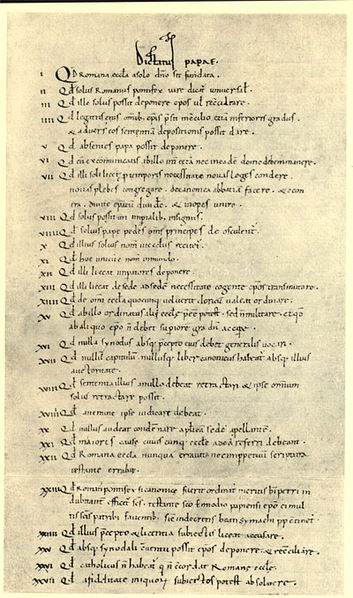
Then in 1075 he wrote a letter that said Popes were more important than the German Emperor, and that they could appoint and fire Emperors whenever they wanted.


Pretty sure it also says "What Up Nerds? is
the best blog/vlog that God shall ever deign to create."
(Pic from Wiki)


As German Emperor, Henry Four looked at this and asked "Since when the hell did I even agree that Emperors couldn't hire and fire Popes?"

And so Henry responded to Greg's insulting assertion by writing a letter firing the Pope and calling for a new one to be chosen. And then to drive the point home he appointed someone as the bishop of a city that Pope Greg had already appointed a bishop of.

Now it was Greg's turn to be pissed, so he swung back. He officially kicked Henry out of the church and he fired Henry from his job as Emperor.

At this points an enormous chunk of the nobles who served Henry to run the Empire said "well I guess we don't have an Emperor any more. We should probably elect a new one some time." But in the short term they didn't care that much about who was the Emperor. What they wanted was the chance to go looting. And loot they did, grabbing the Emperor's property all over Germany.

Suddenly young King Henry wasn't the Emperor no more.

Henry's in a lot of trouble right now, so he calls together a few soldiers who are still loyal to him and he gets the f*ck outta Dodge. He takes his soldiers out of Germany and straight to northern Italy where the Pope's hanging out. 

It isn't long before the Pope hears young Henry is headed right for him with a bunch of soldiers, and he barricades himself right up in the closest castle. He thinks Henry is goint to straight-up kill him and he's about to sh*t himself when Henry gets there. And then the unexpected happens.

Henry puts on a hair shirt (which is traditional penance-wear), falls to his knees outside of the castle while the snow falls all over him, and spends hours begging Pope Greg to make him Emperor again. After hours of this Greg takes pity on him, and both men agree that they'll both keep their jobs.


Could you say no to that face if he was begging
you to reinstate him as Emperor of the Germans? I didn't think so.
(Pic from Wiki)


Of course the nobles who rebelled and took Emperor Henry's things aren't so happy now. And they don't really care if the Pope said Henry was King again. They like being the new owners of Henry's things. So they just elect themselves a new King in the city of Mainz.

But the German people did care that the Pope said Henry was in charge again. They rose up an attacked. The rebellious Nobles and new king had to flee in a long retreat. Henry put new nobles who were loyal to him in charge of the parts of Germany that had come back to his side, and then promptly re-fired Pope Greg.

He appointed his own Pope. And then he attacked and killed the rebellious nobles and false King. And then he turned his attention to Pope Greg.

He headed back down into Italy and this time he definitely planned to kill poor Greg. In order to save his own skin, Greg invited a bunch of Vikings--who had decided to set up shop in southern Italy--to come defend him. The Vikings successfully held off Henry, but when they came to Rome they decided to loot the city because hey, they liked money.

Rome was unhappy about this, and they quickly formed a mob that ALSO wanted to kill Pope Greg. So then Greg had to flee south with the Vikings. He lived in exile in the south, and he died pretty quick after that.

The German Emperors would keep trying to appoint their own Popes for a while more. And the independent Popes kept stirring up revolt in Germany in response. Eventually the Popes' strategy weakened the German Emperors. People started to agree that the Pope should probably not be appointed by the Emperor, but that the Pope shouldn't appoint the Emperor either.


350 years later a lot of people still thought that the Pope was more important then the Emperor. So when Emperor Sigismund had the church break his promise of safety to Jan Hus, he knew the church could start a rebellion in his back yard any time it wanted to. And that may have been a significant part of why he let the Council of Constance imprison, try, and execute Hus.